Practice test 10
33 questions · 60 minutes · pass with 17
Answer every question, then tap Check results. Only then will you see which answers were right.
-
Question 1Not answered
Two friends want to go to a public swimming pool in Germany. Both have a dark skin colour and are therefore not allowed in. Which right is violated in this situation? The right to ...
Correct answer: Equal treatment
Refusing entry because of skin colour violates the right to equal treatment under Article 3 of the Basic Law and §19 of the AGG. Discrimination in access to publicly offered services entitles those affected to damages.
-
Question 2Not answered
In parliament, the term "opposition" stands for...
Correct answer: all MPs who do not belong to the governing party/parties.
The opposition consists of those MPs whose parties are not part of the government. Its core role is to scrutinise the government and offer political alternatives to it.
-
Question 3Not answered
When members of the German Bundestag change their parliamentary group, ...
Correct answer: the government may lose its majority.
Under Article 38 of the Basic Law, MPs are bound only by their conscience and may switch parliamentary groups. If the governing majority is lost as a result, the government can be paralysed or even fall.
-
Question 4Not answered
Which fundamental right in Germany applies only to foreigners? The fundamental right to ...
Correct answer: Asylum
The right to asylum under Article 16a of the Basic Law applies only to politically persecuted foreigners; Germans do not need it in their own country. It was a deliberate response to the experience of Nazi-era refugees.
-
Question 5Not answered
27 January is an official day of remembrance in Germany. What does this day commemorate?
Correct answer: the victims of National Socialism
Since 1996, 27 January has been Germany's day of remembrance for the victims of National Socialism. The date marks the liberation of the Auschwitz concentration camp by the Red Army in 1945.
-
Question 6Not answered
What does this picture show?
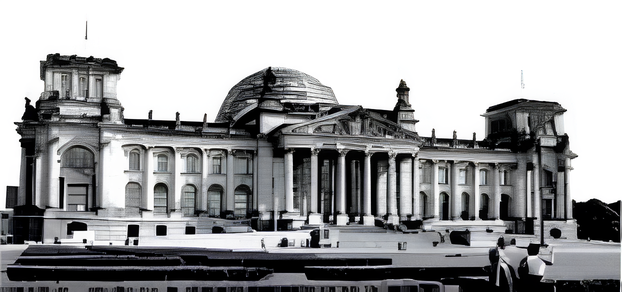
Correct answer: the seat of the Bundestag in Berlin
The seat of the Bundestag is the Reichstag building in Berlin, with its glass dome by Norman Foster. Parliament has met here since 1999; the building was completed in 1894 to plans by Paul Wallot.
-
Question 7Not answered
When does a trial take place in court in Germany? When someone ...
Correct answer: has committed a criminal offence and is charged with it.
A criminal trial takes place when the public prosecutor charges someone with an offence and the court admits the indictment. Until a final judgement the defendant is presumed innocent, a core rule-of-law principle in German criminal procedure.
-
Question 8Not answered
What was the economic system of the GDR called?
Correct answer: Planned economy
The GDR operated a centrally planned economy: the state owned the means of production and set output quotas and prices in five-year plans. Private ownership of businesses and free competition were effectively absent.
-
Question 9Not answered
Pentecost is a ...
Correct answer: Christian holiday.
Pentecost is a Christian holiday celebrated 50 days after Easter, commemorating the descent of the Holy Spirit on the Apostles. Pentecost Monday is a public holiday in all federal states.
-
Question 10Not answered
In Germany, children from the age of three until they start school are entitled to ...
Correct answer: a place in a kindergarten.
Since 2013, every child has had a statutory right under §24 SGB VIII to a daycare place from their first birthday until school entry; from age three specifically to a kindergarten place. Municipalities must provide enough places.
-
Question 11Not answered
What is the German constitution called?
Correct answer: Basic Law
Germany's constitution is called the Basic Law (Grundgesetz) and came into force on 23 May 1949. The name was deliberately chosen to signal a provisional character until reunification; since 1990 it applies in all of Germany.
-
Question 12Not answered
Freedom of opinion in Germany means that I ...
Correct answer: can express my opinion in letters to the editor.
Freedom of expression under Article 5 also covers publishing one's views, for example in letters to the editor, demonstrations or online. It ends where general laws, youth protection or the personal honour of others would be infringed.
-
Question 13Not answered
What was the name of the first Chancellor of the Federal Republic of Germany?
Correct answer: Konrad Adenauer
Konrad Adenauer (CDU) was the first Chancellor of the Federal Republic of Germany from 1949 to 1963. He shaped West Germany's integration with the Western alliance, its close ties with the United States, and the founding of the EEC, forerunner of the EU.
-
Question 14Not answered
In which period did the German Democratic Republic (GDR) exist?
Correct answer: 1949 to 1990
The GDR existed from 7 October 1949 until 2 October 1990. It was proclaimed in the Soviet occupation zone after the founding of the Federal Republic and ended with reunification.
-
Question 15Not answered
Who pays for social security in Germany?
Correct answer: Employers and employees
Social insurance contributions are generally split between employer and employee. Each side pays roughly half of the contributions for health, pension, unemployment and long-term care insurance.
-
Question 16Not answered
What is not a state authority in Germany?
Correct answer: Directive
The three branches of state power in Germany are the legislature (lawmaking), executive (administration) and judiciary (courts). A "directive" is merely an instruction or guideline and is not an independent branch of state power under the Basic Law.
-
Question 17Not answered
In Germany, a judge belongs to the ...
Correct answer: judicial power.
Judges belong to the judicial power (rechtsprechende Gewalt). Article 20(2) of the Basic Law divides state power into legislative, executive and judicial branches – Montesquieu's classic principle for guarding against the abuse of power.
-
Question 18Not answered
To whom did the GDR belong during the "Cold War"?
Correct answer: to the Warsaw Pact
The GDR belonged to the Warsaw Pact, the Eastern Bloc military alliance founded in 1955 under Soviet leadership. The Federal Republic was a member of its Western counterpart, NATO; the Pact dissolved in 1991.
-
Question 19Not answered
In which year was the Berlin Wall built?
Correct answer: 1961
The Berlin Wall was built on 13 August 1961 by the GDR to stop the mass flight of its citizens through West Berlin to the Federal Republic. It stood for 28 years, until the fall of the Wall on 9 November 1989.
-
Question 20Not answered
With which words does the German national anthem begin?
Correct answer: Unity and justice and freedom ...
The German national anthem begins with the words "Unity and Justice and Freedom." Since 1952 only the third stanza of Hoffmann von Fallersleben's Deutschlandlied (1841) is sung, set to a melody by Joseph Haydn.
-
Question 21Not answered
What is an example of anti-Semitic behaviour?
Correct answer: denying the Holocaust
Denying the Holocaust is anti-Semitic and a criminal offence under Section 130(3) of the German Penal Code (incitement to hatred). Publicly denying, approving or trivialising the Nazi genocide can be punished with up to five years' imprisonment.
-
Question 22Not answered
Who is elected in the European elections?
Correct answer: the members of the European Parliament
In the European elections, voters choose the members of the European Parliament. Germany currently sends 96 of the 720 total MEPs.
-
Question 23Not answered
What do you call a procedure before a court in Germany?
Correct answer: Process
A procedure before a German court is called a Prozess (trial or proceedings) – in criminal law a Strafprozess, in civil matters a Zivilprozess. The term covers the regulated path from the lawsuit or indictment to the judgement.
-
Question 24Not answered
In 1953 there was an uprising in the GDR, which for a long time was commemorated by a public holiday in the Federal Republic of Germany. When was that?
Correct answer: 17 June
On 17 June 1953 workers and citizens in the GDR rose up against the SED regime; the uprising was crushed with the help of Soviet tanks. Until 1990, 17 June was a public holiday in West Germany called Day of German Unity.
-
Question 25Not answered
What is the youth welfare office allowed to do in Germany?
Correct answer: It can remove a child from the family if it is being beaten or is starving.
If a child's welfare is acutely at risk, §42 SGB VIII allows the youth welfare office to take the child into care and remove it from the family. A longer-term separation must then be decided by the family court.
-
Question 26Not answered
How many member states does the EU have today?
Correct answer: 27
Since the United Kingdom's withdrawal on 1 February 2020, the EU has 27 member states. The most recent enlargement was Croatia in 2013.
-
Question 27Not answered
What is the minimum percentage of second votes that parties must receive in order to be elected to the German Bundestag?
Correct answer: 5 %
Under the so-called five-percent threshold a party must win at least 5 % of nationwide second votes to enter the Bundestag. Alternatively, securing three direct constituency seats (Grundmandatsklausel) under Section 6 of the Federal Election Act is enough.
-
Question 28Not answered
Where does the German Chancellor spend the most time? He/she is most often ...
Correct answer: in Berlin, because the Federal Chancellery and the Bundestag are located there.
Since the 1991 capital decision, Berlin has again been the seat of government; the Chancellery and the Bundestag are located in the government quarter around the Spree bend. The Chancellor therefore works mainly in Berlin.
-
Question 29Not answered
You deliberately opened a letter addressed to another person in Germany. What did you disregard?
Correct answer: the secrecy of correspondence
The secrecy of correspondence is guaranteed by Article 10 of the Basic Law and protects the confidentiality of written communication. Deliberately opening someone else's mail is a criminal offence under §202 StGB.
-
Question 30Not answered
A party in Germany is pursuing the goal of establishing a dictatorship. It is then ...
Correct answer: unconstitutional.
Parties seeking to abolish the free democratic basic order are unconstitutional under Article 21(2). Only the Federal Constitutional Court can ban them, as it did with the SRP in 1952 and the KPD in 1956.

-
Question 31Not answered
Which federal state is Baden-Württemberg?
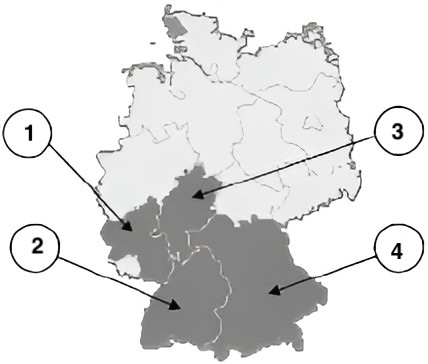
Correct answer: Picture 2
Baden-Württemberg lies in south-western Germany and borders France and Switzerland. It was formed in 1952 by merging the former states of Württemberg-Baden, Baden and Württemberg-Hohenzollern.
-
Question 32Not answered
What do you call the head of government in Baden-Württemberg?
Correct answer: Minister-President
The head of government of a German territorial state such as Baden-Württemberg holds the title of Minister-President. He or she is elected by the state parliament and leads the cabinet.
-
Question 33Not answered
Which minister does Baden-Württemberg not have?
Correct answer: Foreign Minister
Foreign policy is constitutionally a federal matter, not a state one. Baden-Württemberg therefore has no foreign minister; external relations are handled federally by the German Foreign Office.

-
Question 31Not answered
Which federal state is Bavaria?
Correct answer: Picture 4
Bavaria lies in south-eastern Germany and, at about 70,500 square kilometres, is the largest federal state by area. It borders Austria and the Czech Republic and is officially named the Free State of Bavaria.
-
Question 32Not answered
What do you call the head of government in Bavaria?
Correct answer: Minister-President
Bavaria's head of government holds the title Minister-President and is elected by the state parliament. He leads the cabinet and represents the Free State externally, including in the federal Bundesrat.
-
Question 33Not answered
Which minister does Bavaria not have?
Correct answer: Foreign Minister
Foreign policy is a federal matter under the Basic Law, so Bavaria, like all states, has no foreign minister. Its cabinet instead covers areas such as interior, finance, justice and education.

-
Question 31Not answered
Which federal state is Berlin?
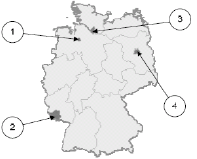
Correct answer: Picture 4
Since reunification in 1990 Berlin has again been Germany's capital and at the same time its own federal state in the form of a city-state. The city is fully surrounded by the state of Brandenburg.
-
Question 32Not answered
What do you call the head of government of the city state of Berlin?
Correct answer: Governing Mayor / Governing Mayoress
Berlin's head of government is called the Governing Mayor and leads the Berlin Senate. This title is unique to Berlin among Germany's federal states.
-
Question 33Not answered
Which senator does Berlin not have?
Correct answer: Senator for External Relations
External relations are a federal responsibility, so the Berlin Senate has no Senator for External Relations. The Senate instead covers areas such as interior, finance, justice, education and urban development.

-
Question 31Not answered
Which federal state is Brandenburg?
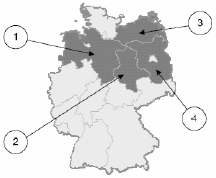
Correct answer: Picture 4
Brandenburg lies in north-eastern Germany and fully surrounds the federal capital Berlin. The state was re-established as a federal state in 1990 with German reunification.
-
Question 32Not answered
What do you call the head of government in Brandenburg?
Correct answer: Minister-President
Brandenburg's head of government holds the title of Minister-President and is elected by the state parliament in Potsdam. He leads the cabinet and represents the state in the federal Bundesrat.
-
Question 33Not answered
Which minister does Brandenburg not have?
Correct answer: Foreign Minister
Foreign policy is a federal responsibility, so Brandenburg, like all states, has no foreign minister. The state cabinet instead covers areas such as interior, finance, education and agriculture.

-
Question 31Not answered
Which federal state is Bremen?
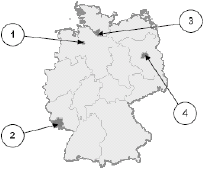
Correct answer: Picture 1
The Free Hanseatic City of Bremen lies in north-western Germany and comprises the two non-contiguous cities of Bremen and Bremerhaven, both surrounded by Lower Saxony. Bremen hosts major ports and shipyards.
-
Question 32Not answered
What do you call the head of government of the city state of Bremen?
Correct answer: President of the Senate
Bremen's head of government holds the title President of the Senate and is simultaneously Mayor of the city of Bremen. He leads the Bremen Senate and represents the state externally.
-
Question 33Not answered
Which senator does Bremen not have?
Correct answer: Senator for External Relations
External relations are constitutionally a federal matter, so Bremen's Senate has no Senator for External Relations. Its portfolios instead cover interior, finance, education and ports.

-
Question 31Not answered
Which federal state is Hamburg?
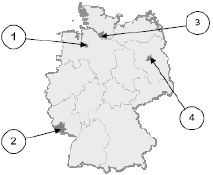
Correct answer: Picture 3
The Free and Hanseatic City of Hamburg lies in northern Germany on the Elbe and is a city-state. The Port of Hamburg is Europe's third-largest container port.
-
Question 32Not answered
What do you call the head of government of the city state of Hamburg?
Correct answer: First Mayor / First Mayoress
Hamburg's head of government holds the title First Mayor and leads the Hamburg Senate. The title distinguishes the office from ordinary mayors of other cities.
-
Question 33Not answered
Which senator does Hamburg not have?
Correct answer: Senator for External Relations
Foreign policy is a federal matter, so Hamburg's Senate has no Senator for External Relations. Instead it has portfolios such as interior, finance, justice, schools and economy/ports.

-
Question 31Not answered
Which federal state is Hesse?
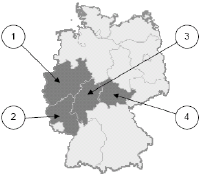
Correct answer: Picture 3
Hesse lies in central Germany, stretching from the Rhine-Main area in the south to the highlands in the north. Its economic centre is the banking metropolis of Frankfurt am Main.
-
Question 32Not answered
What do you call the head of government in Hesse?
Correct answer: Minister-President
Hesse's head of government holds the title Minister-President and is elected by the state parliament in Wiesbaden. He leads the cabinet and represents Hesse in the federal Bundesrat.
-
Question 33Not answered
Which minister does Hesse not have?
Correct answer: Foreign Minister
Foreign policy is a federal matter under the Basic Law, so Hesse has no foreign minister. Its cabinet instead covers areas such as interior, finance, justice, education and economy.

-
Question 31Not answered
Which federal state is Mecklenburg-Vorpommern?
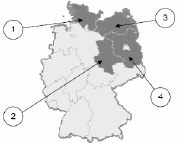
Correct answer: Picture 3
Mecklenburg-Vorpommern lies in north-eastern Germany on the Baltic and was re-established in 1990 with reunification, combining the former Rostock, Schwerin and Neubrandenburg districts. It is the most sparsely populated territorial state.
-
Question 32Not answered
What do you call the head of government in Mecklenburg-Vorpommern?
Correct answer: Minister-President
Mecklenburg-Vorpommern's head of government holds the title Minister-President and is elected by the state parliament in Schwerin. He leads the cabinet and represents the state in the federal Bundesrat.
-
Question 33Not answered
Which minister does Mecklenburg-Vorpommern not have?
Correct answer: Foreign Minister
Foreign policy is a federal responsibility, so Mecklenburg-Vorpommern, like all states, has no foreign minister. Its cabinet covers areas such as interior, finance, education, justice and agriculture.

-
Question 31Not answered
Which federal state is Lower Saxony?
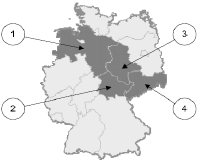
Correct answer: Picture 1
Lower Saxony is Germany's second-largest state by area, stretching from the North Sea to the Harz and Weser. It was created in 1946 by merging Hannover, Oldenburg, Brunswick and Schaumburg-Lippe.
-
Question 32Not answered
What do you call the head of government in Lower Saxony?
Correct answer: Minister-President
Lower Saxony's head of government is the Minister-President, elected by the state parliament. They lead the state cabinet, appoint ministers and represent the state in the Bundesrat.
-
Question 33Not answered
Which minister does Lower Saxony not have?
Correct answer: Foreign Minister
Foreign policy is a federal responsibility under the Basic Law, not a state matter. Lower Saxony therefore has no Foreign Minister; the Federal Foreign Office in Berlin handles diplomacy for all states.

-
Question 31Not answered
Which federal state is North Rhine-Westphalia?
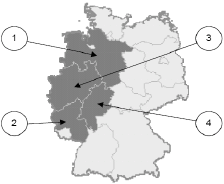
Correct answer: Picture 3
North Rhine-Westphalia is Germany's most populous state, with almost 18 million inhabitants. Lying in the west on the borders with the Netherlands and Belgium, it was founded in 1946 under British occupation.
-
Question 32Not answered
What do you call the head of government in North Rhine-Westphalia?
Correct answer: Minister-President
North Rhine-Westphalia's head of government is the Minister-President, elected by the state parliament. They lead the cabinet in Düsseldorf, set policy guidelines and appoint the ministers.
-
Question 33Not answered
Which minister does North Rhine-Westphalia not have?
Correct answer: Foreign Minister
Foreign policy is a federal matter, so North Rhine-Westphalia has no Foreign Minister. The Federal Foreign Office in Berlin is responsible; the state does, however, maintain its own representation to the federal government.

-
Question 31Not answered
Which federal state is Rhineland-Palatinate?
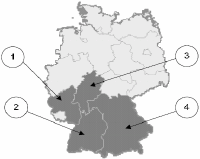
Correct answer: Picture 1
Rhineland-Palatinate in western Germany was founded in 1946 and borders France, Luxembourg and Belgium. The state is renowned for its wine regions along the Rhine, Moselle and Ahr rivers.
-
Question 32Not answered
What do you call the head of government in Rhineland-Palatinate?
Correct answer: Minister-President
Rhineland-Palatinate's head of government holds the title of Minister-President and is elected by the state parliament. They head the state chancellery in Mainz and represent the state in the Bundesrat.
-
Question 33Not answered
Which minister does Rhineland-Palatinate not have?
Correct answer: Foreign Minister
Foreign policy is a federal responsibility, so no state has a Foreign Minister. Rhineland-Palatinate does, however, maintain a state representation in Berlin and offices in Brussels.

-
Question 31Not answered
Which federal state is Saarland?
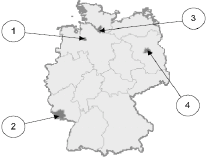
Correct answer: Picture 2
Saarland is the smallest German territorial state by area and population, surpassed only by the city-states. After WWII it was administered by France and joined the Federal Republic in 1957.
-
Question 32Not answered
What do you call the head of government of Saarland?
Correct answer: Minister-President
Saarland's head of government is called the Minister-President, elected by the state parliament. They head the state chancellery in Saarbrücken and represent Saarland in the Bundesrat in Berlin.
-
Question 33Not answered
Which minister does Saarland not have?
Correct answer: Foreign Minister
Foreign policy is a federal competence, so Saarland has no Foreign Minister. Due to its proximity to France, it does maintain especially close cross-border ties through the SaarLorLux Greater Region.

-
Question 31Not answered
Which federal state is Saxony?
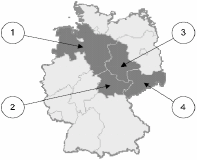
Correct answer: Picture 4
Saxony is a Free State in eastern Germany and one of the five new states formed after reunification in 1990. It borders Poland and the Czech Republic and has about four million inhabitants.
-
Question 32Not answered
What do you call the head of government in Saxony?
Correct answer: Minister-President
Saxony's head of government is called the Minister-President, elected by the state parliament. They lead the state government in Dresden and represent the Free State in the Bundesrat.
-
Question 33Not answered
Which minister does Saxony not have?
Correct answer: Foreign Minister
Foreign policy is exclusively a federal matter, so the Free State of Saxony has no Foreign Minister. The Federal Foreign Office in Berlin handles diplomacy.

-
Question 31Not answered
Which federal state is Saxony-Anhalt?
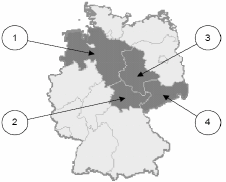
Correct answer: Picture 3
Saxony-Anhalt lies in central Germany and was re-established in 1990 with reunification. The cradle of the Reformation, it hosts UNESCO sites including Wittenberg, Quedlinburg and the Bauhaus in Dessau.
-
Question 32Not answered
What do you call the head of government in Saxony-Anhalt?
Correct answer: Minister-President
Saxony-Anhalt's head of government is called the Minister-President, elected by the state parliament. They lead the state chancellery in Magdeburg and represent the state in the Bundesrat.
-
Question 33Not answered
Which minister does Saxony-Anhalt not have?
Correct answer: Foreign Minister
Foreign policy rests with the federal government under the Basic Law, so Saxony-Anhalt has no Foreign Minister. The Federal Foreign Office in Berlin is responsible.

-
Question 31Not answered
Which federal state is Schleswig-Holstein?
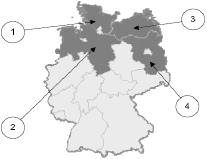
Correct answer: Picture 1
Schleswig-Holstein is Germany's northernmost state, lying between the North and Baltic Seas. It borders Denmark; the duchies passed to Prussia after the Second Schleswig War of 1864.
-
Question 32Not answered
What do you call the head of government in Schleswig-Holstein?
Correct answer: Minister-President
Schleswig-Holstein's head of government is the Minister-President, elected by the state parliament. They head the state chancellery in Kiel and represent the state in the Bundesrat.
-
Question 33Not answered
Which minister does Schleswig-Holstein not have?
Correct answer: Foreign Minister
Foreign policy is a federal task, so Schleswig-Holstein has no Foreign Minister. Given its location, the state nevertheless maintains close ties with Denmark and the wider Baltic region.

-
Question 31Not answered
Which federal state is Thuringia?
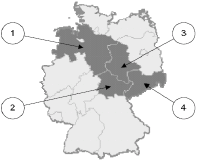
Correct answer: Picture 2
Thuringia lies at the heart of Germany and is often called the Green Heart. The Free State was re-established at reunification in 1990 and is home to UNESCO sites such as Weimar and the Wartburg.
-
Question 32Not answered
What do you call the head of government in Thuringia?
Correct answer: Minister-President
Thuringia's head of government is called the Minister-President, elected by the state parliament. They lead the Thuringian state chancellery in Erfurt and represent the state in the Bundesrat.
-
Question 33Not answered
Which minister does Thuringia not have?
Correct answer: Foreign Minister
Foreign policy falls under the exclusive competence of the federal government, so Thuringia has no Foreign Minister. The Federal Foreign Office in Berlin handles such matters.

Your result
/ 33 correct
You pass with 17 or more correct answers.