Practice test 4
33 questions · 60 minutes · pass with 17
Answer every question, then tap Check results. Only then will you see which answers were right.
-
Question 1Not answered
In Germany, state power is divided. For which state authority does a judge work? For the ...
Correct answer: Judiciary.
A judge works for the judicature, the third of the three state powers. The other two are the legislature (lawmaking, such as Bundestag and Bundesrat) and the executive (carrying out the law, such as government and administration).
-
Question 2Not answered
How many occupation zones were there in Germany after the Second World War?
Correct answer: 4
After the Second World War the victorious powers divided Germany in 1945 into four occupation zones: American, British, French and Soviet. Berlin too was split into four sectors.
-
Question 3Not answered
When was the GDR founded?
Correct answer: 1949
The German Democratic Republic was founded on 7 October 1949 in the Soviet occupation zone – only months after the Federal Republic, which was founded on 23 May 1949. Germany was then officially split into two states.
-
Question 4Not answered
Which office is part of the local government in Germany?
Correct answer: Public order office
The public order office (Ordnungsamt) is a municipal authority and part of the local government. It handles tasks such as trade supervision, traffic regulation and local public safety.
-
Question 5Not answered
What was the "Stasi"?
Correct answer: the secret service of the GDR
The Ministry for State Security, or Stasi, was the GDR's secret service from 1950 to 1990. It conducted mass surveillance of its own population through full-time officers and unofficial informants and persecuted political opponents.
-
Question 6Not answered
Which ballot paper would be valid in a general election?
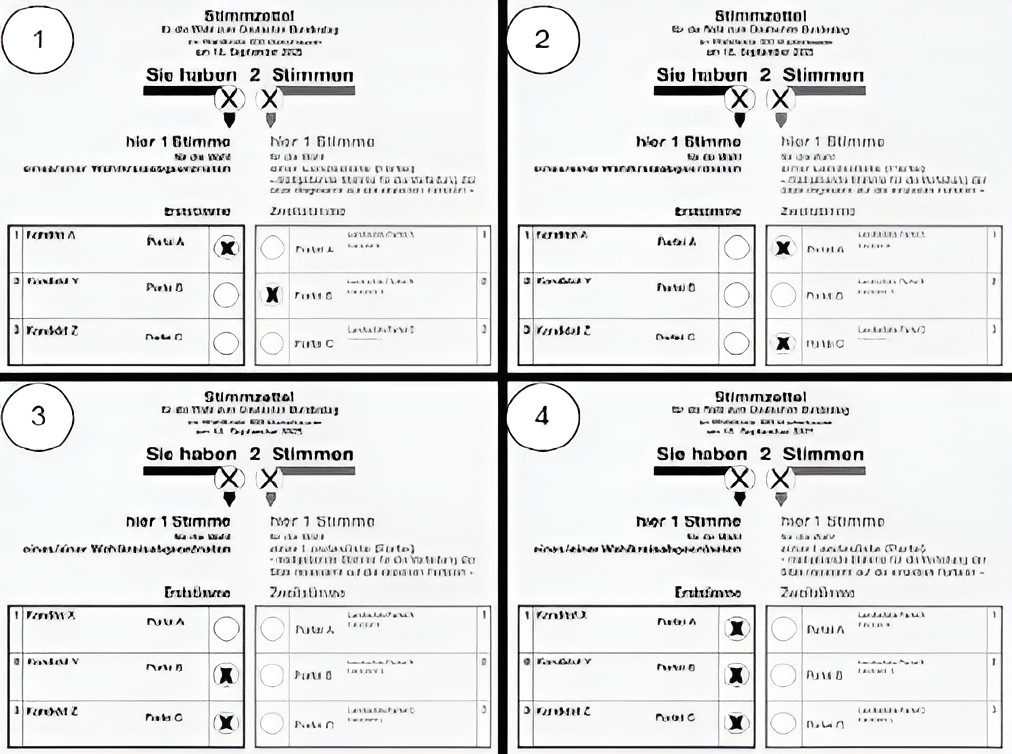
Correct answer: Picture 1
A ballot is valid if the voter's choice is clearly recognisable: exactly one clean cross per first and second vote, with no extra marks, comments or signature. Multiple crosses, crossings-out or added notes make the ballot invalid.
-
Question 7Not answered
Which body is not one of Germany's constitutional bodies?
Correct answer: the Citizens' Assembly
Germany's permanent federal constitutional bodies are the Bundestag, Bundesrat, Federal Government, Federal President and Federal Constitutional Court, plus the Federal Convention. A "citizens' assembly" is not a constitutional body provided for in the Basic Law.
-
Question 8Not answered
It is not part of a democratic constitutional state that ...
Correct answer: people are arrested by a private police force without reason.
In a constitutional state, only the state has the monopoly on the use of force; arbitrary arrests by a private police force would be unlawful and violate the liberty rights guaranteed in Articles 2 and 104 of the Basic Law.
-
Question 9Not answered
Which military alliance was the GDR a member of?
Correct answer: in the Warsaw Pact
The GDR was a member of the Warsaw Pact, the Soviet-led military alliance founded in 1955. West Germany belonged to the opposing NATO alliance; the two blocs faced each other throughout the Cold War.
-
Question 10Not answered
What is the coat of arms of the Federal Republic of Germany?
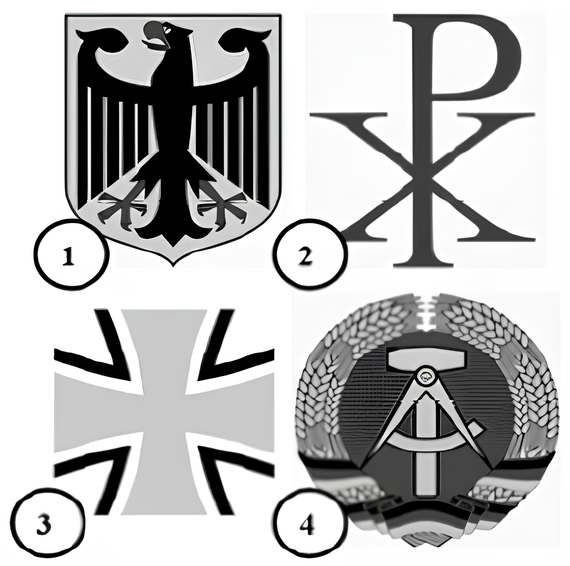
Correct answer: Picture 1
The federal coat of arms shows a black eagle with red beak and claws on a gold shield. It dates back to the coat of arms of the Weimar Republic of 1919 and remains the official state emblem today.
-
Question 11Not answered
In Germany, the education of children is primarily the responsibility ...
Correct answer: of the parents.
Under Article 6(2) of the Basic Law, the care and upbringing of children is the natural right and primary duty of the parents. Schools and the youth welfare office assist but may intervene only if a child's welfare is at risk.
-
Question 12Not answered
When was the Federal Republic of Germany founded?
Correct answer: 1949
The Federal Republic of Germany was founded on 23 May 1949 with the proclamation of the Basic Law. It grew out of the three western occupation zones; the GDR was founded in the Soviet sector later the same year, on 7 October 1949.
-
Question 13Not answered
On 3 October, Germany celebrates the Day of German ...
Correct answer: Unity.
On 3 October Germany celebrates the Day of German Unity. It marks the GDR's accession to the Federal Republic on 3 October 1990 and is the only federal statutory public holiday, set out in Article 2 of the Unification Treaty.
-
Question 14Not answered
What characterised the Nazi state? A policy ...
Correct answer: of state racism
The Nazi state was defined by a policy of state racism: people were classified by an alleged race, and Jews, Sinti and Roma, Slavs and others were systematically stripped of rights and murdered by the millions in the Holocaust.
-
Question 15Not answered
Which right is one of the fundamental rights guaranteed by the German constitution? The right to ...
Correct answer: Freedom of belief and conscience
Article 4 of the Basic Law guarantees freedom of faith, conscience and creed. Everyone may freely choose to follow a religion or none and to practise their beliefs without interference from the state.
-
Question 16Not answered
With the accession of the GDR to the Federal Republic of Germany, the new federal states now also belong ...
Correct answer: to the European Union.
Through the 1990 accession, the new federal states automatically became part of the then European Community, today's European Union. No separate accession negotiations were needed.
-
Question 17Not answered
The German state has many tasks. Which task is one of them?
Correct answer: It builds roads and schools.
One of the state's core tasks is to provide public infrastructure such as roads, schools and hospitals. This "public provisioning" follows from the social-state principle in Article 20 of the Basic Law.
-
Question 18Not answered
In Germany, co-operation between parties to form a government is called ...
Correct answer: Coalition.
A coalition is an alliance of two or more parties that together form a parliamentary majority and sign a coalition agreement. Since one party rarely wins an outright majority in the Bundestag, coalitions are the norm.
-
Question 19Not answered
In Germany, parents can decide up to the age of 14 whether their child takes part in ...
Correct answer: Religious education.
Religious education is a regular school subject in Germany but is voluntary: until age 14, when children reach religious majority, parents decide; afterwards the child decides. Pupils who opt out usually take an ethics or values course instead.
-
Question 20Not answered
In Germany, voluntary election assistants help with the elections. What is one of the tasks of poll workers?
Correct answer: They count the votes at the end of the election.
Poll workers are citizens who volunteer at a polling station and publicly count the votes after the station closes. Their unpaid civic engagement secures an independent, traceable count and so the public trust in the result.
-
Question 21Not answered
Claus Schenk Graf von Stauffenberg became famous for ...
Correct answer: the assassination attempt on Hitler on 20 July 1944.
Claus Schenk Graf von Stauffenberg carried out the assassination attempt on Hitler at the Wolf's Lair on 20 July 1944. His bomb exploded but Hitler survived; Stauffenberg and his fellow conspirators were executed the same night.
-
Question 22Not answered
A married couple would like to open a restaurant in Germany. What do they absolutely need?
Correct answer: a restaurant licence from the competent authority
Running a restaurant that serves alcoholic drinks requires a Gaststättenerlaubnis under the Restaurant Act. The municipality or public order office issues it after checking reliability, premises and proof of hygiene training.
-
Question 23Not answered
What is not part of statutory social insurance?
Correct answer: life insurance
Statutory social insurance comprises the five pillars of health, pension, unemployment, accident and long-term care insurance. Life insurance, by contrast, is a voluntary private form of provision and is not part of statutory social insurance.
-
Question 24Not answered
An adult woman wants to do her A-levels in Germany. She can do this at ...
Correct answer: an evening grammar school.
Working adults can earn the Abitur at an Abendgymnasium. Classes are held in the evening alongside employment, and the general higher education entrance qualification can be obtained after three to four years.
-
Question 25Not answered
How does the German state finance social security?
Correct answer: Social security contributions
Germany's social insurance system is funded mainly by contributions from employees and employers, the so-called social security contributions. These are deducted directly from wages and are distinct from taxes.
-
Question 26Not answered
Who advises people in Germany on legal issues and represents them in court?
Correct answer: a lawyer
Lawyers (Rechtsanwälte) advise clients on legal questions and represent them in court. They are independent organs of the administration of justice under Section 1 BRAO; representation by a lawyer is mandatory in many higher proceedings, such as before the regional court.
-
Question 27Not answered
What is the accession of the GDR to the Federal Republic of Germany in 1990 generally called?
Correct answer: German reunification
The GDR's accession to the Federal Republic on 3 October 1990 is known as German reunification. The day has since been observed as the Day of German Unity, a public holiday.
-
Question 28Not answered
How many inhabitants does Germany have?
Correct answer: 84 million
Germany has around 84 million inhabitants, making it the most populous country in the European Union. The figure is continuously updated by the Federal Statistical Office.
-
Question 29Not answered
What is compatible with the German constitution?
Correct answer: the fine
Fines are regulated in § 40 of the Criminal Code and are constitutional. Torture, corporal punishment and the death penalty all violate human dignity (Art. 1); Article 102 of the Basic Law expressly abolishes capital punishment.
-
Question 30Not answered
Which of the following lists contains only federal states that belonged to the territory of the former GDR?
Correct answer: Mecklenburg-Western Pomerania, Brandenburg, Saxony, Saxony-Anhalt, Thuringia
Five new federal states emerged from the GDR (1949–1990) after reunification: Mecklenburg-Western Pomerania, Brandenburg, Saxony, Saxony-Anhalt and Thuringia. Berlin, as a divided city, is usually treated separately.


-
Question 31Not answered
Which minister does Baden-Württemberg not have?
Correct answer: Foreign Minister
Foreign policy is constitutionally a federal matter, not a state one. Baden-Württemberg therefore has no foreign minister; external relations are handled federally by the German Foreign Office.
-
Question 32Not answered
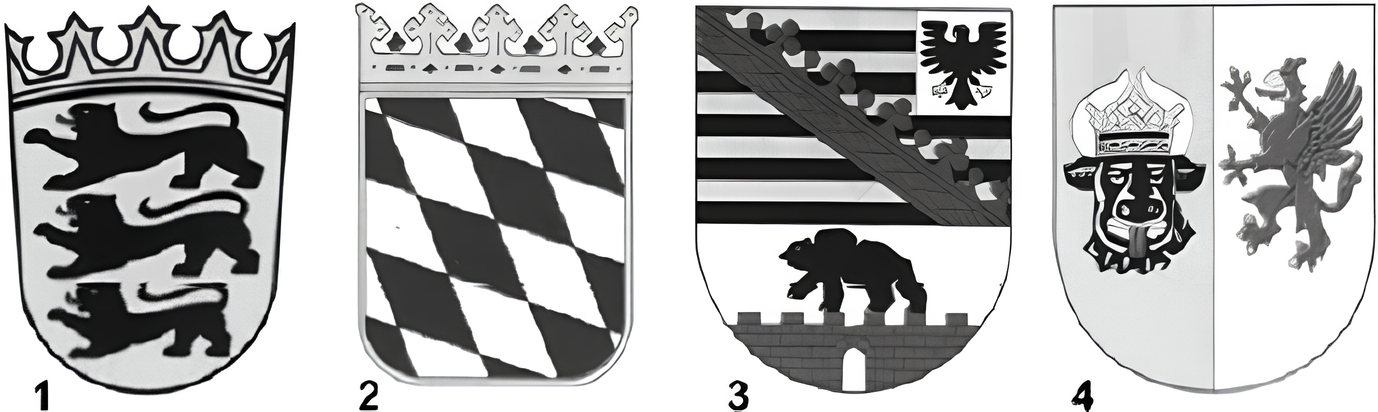
Which coat of arms belongs to the federal state of Baden-Württemberg?
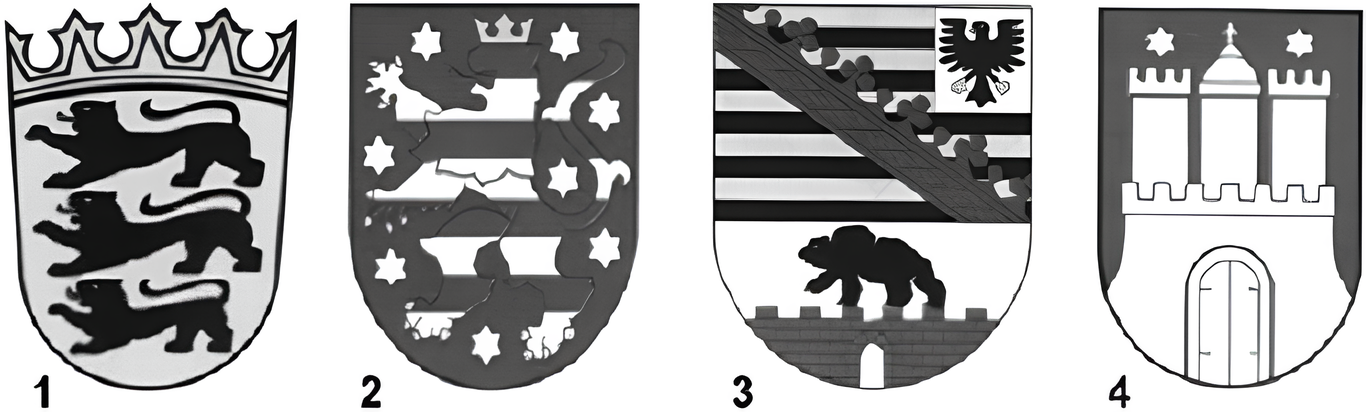
Correct answer: Picture 1
Baden-Württemberg's coat of arms shows three black walking lions on a gold field, derived from the Staufer Duchy of Swabia. The current design dates back to the state's founding in 1952.
-
Question 33Not answered
Which is a district in Baden-Württemberg?
Correct answer: Neckar-Odenwald district
The Neckar-Odenwald district lies in north-eastern Baden-Württemberg with its administrative seat in Mosbach and is one of the state's 35 rural districts. It was created in the 1973 district reform by merging the former Buchen and Mosbach districts.

-
Question 31Not answered
Which minister does Bavaria not have?
Correct answer: Foreign Minister
Foreign policy is a federal matter under the Basic Law, so Bavaria, like all states, has no foreign minister. Its cabinet instead covers areas such as interior, finance, justice and education.
-
Question 32Not answered
Which coat of arms belongs to the Free State of Bavaria?
Correct answer: Picture 2
Bavaria's large state coat of arms features the famous white-and-blue lozenges of the Wittelsbachs in its inescutcheon, alongside fields with the Palatinate lion, the Franconian rake and the Veldenz lion. Bavaria officially holds the title Free State.
-
Question 33Not answered
Which is a district in Bavaria?
Correct answer: Altötting
Altötting is a rural district in Upper Bavaria with its seat in Altötting town, famous as a major Catholic pilgrimage site with the Chapel of the Black Madonna. Bavaria has 71 rural districts in total.

-
Question 31Not answered
Which senator does Berlin not have?
Correct answer: Senator for External Relations
External relations are a federal responsibility, so the Berlin Senate has no Senator for External Relations. The Senate instead covers areas such as interior, finance, justice, education and urban development.
-
Question 32Not answered
Which coat of arms belongs to the federal state of Berlin?
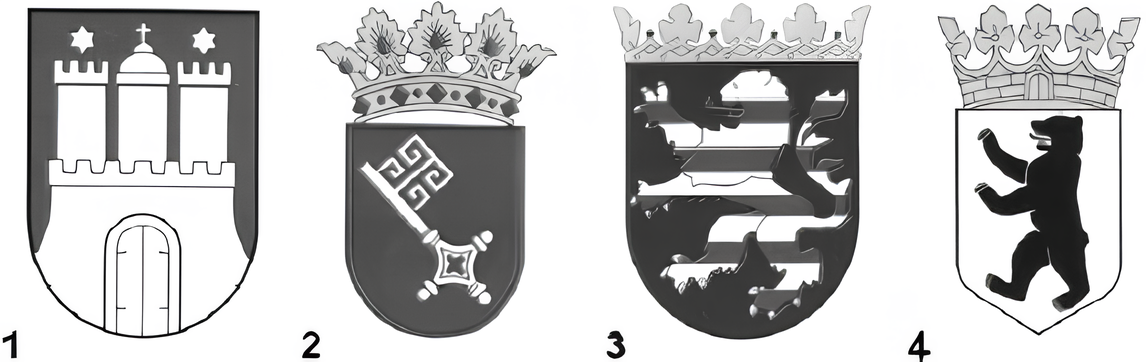
Correct answer: Picture 4
Berlin's coat of arms shows an upright black bear on a white shield, topped with a golden mural crown. The Berlin bear has been the city's emblem since the 13th century.
-
Question 33Not answered
Which is a district of Berlin?
Correct answer: Pankow
Pankow is one of Berlin's twelve boroughs, lying in the north-east with about 410,000 residents. Berlin's boroughs handle municipal tasks that elsewhere fall to towns and municipalities.

-
Question 31Not answered
Which minister does Brandenburg not have?
Correct answer: Foreign Minister
Foreign policy is a federal responsibility, so Brandenburg, like all states, has no foreign minister. The state cabinet instead covers areas such as interior, finance, education and agriculture.
-
Question 32Not answered
Which coat of arms belongs to the federal state of Brandenburg?
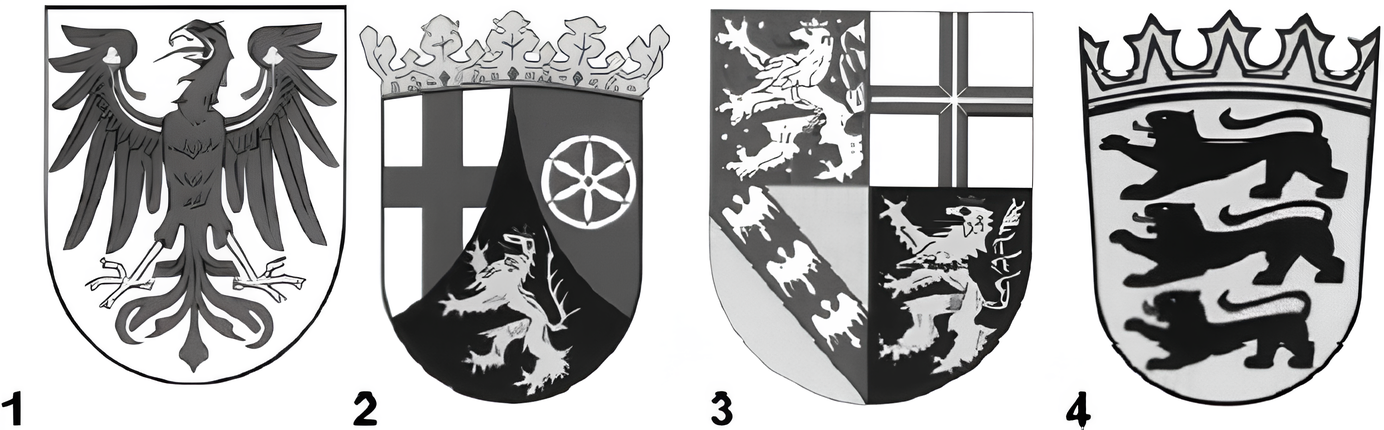
Correct answer: Picture 1
Brandenburg's coat of arms shows a red eagle with golden talons on a white shield. The Brandenburg eagle dates back to the Margraves of Brandenburg in the 12th century.
-
Question 33Not answered
Which is a district in Brandenburg?
Correct answer: Prignitz
Prignitz is a rural district in north-western Brandenburg with its seat in Perleberg. Brandenburg is divided into 14 rural districts and four independent cities surrounding the capital Potsdam.

-
Question 31Not answered
Which senator does Bremen not have?
Correct answer: Senator for External Relations
External relations are constitutionally a federal matter, so Bremen's Senate has no Senator for External Relations. Its portfolios instead cover interior, finance, education and ports.
-
Question 32Not answered
Which coat of arms belongs to the Free Hanseatic City of Bremen?
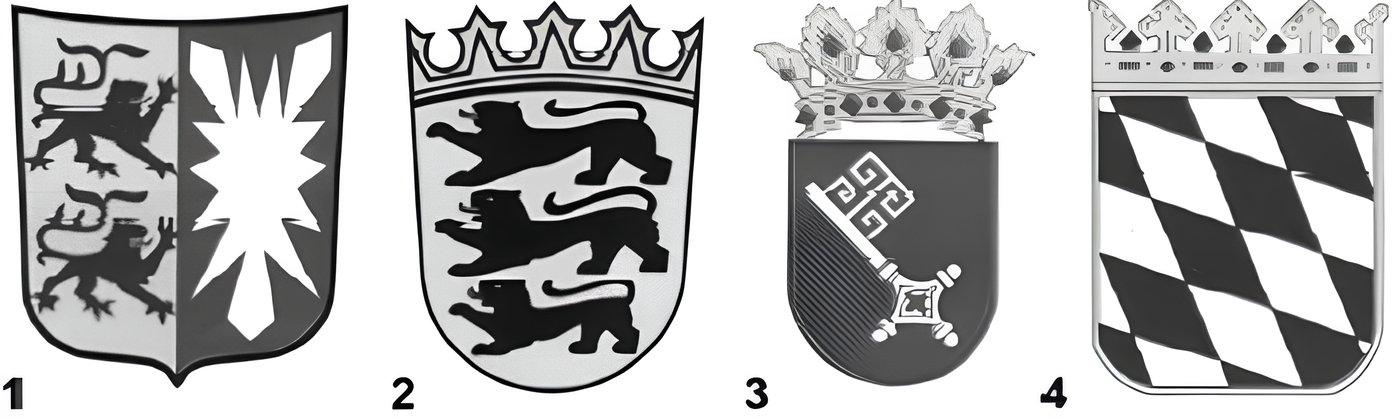
Correct answer: Picture 3
The arms of the Free Hanseatic City of Bremen show a silver key with the bit pointing upwards on a red field. The key refers to Saint Peter, patron of Bremen Cathedral.
-
Question 33Not answered
Which is a district of Bremen?
Correct answer: Hemelingen
Hemelingen is one of Bremen city's five boroughs, located in the south-east along the Weser river. The federal state of Bremen consists of the two cities of Bremen and Bremerhaven.

-
Question 31Not answered
Which senator does Hamburg not have?
Correct answer: Senator for External Relations
Foreign policy is a federal matter, so Hamburg's Senate has no Senator for External Relations. Instead it has portfolios such as interior, finance, justice, schools and economy/ports.
-
Question 32Not answered
Which coat of arms belongs to the Free and Hanseatic City of Hamburg?
Correct answer: Picture 2
Hamburg's coat of arms shows a white castle with three towers on a red field, symbolising the Hanseatic city's independence. The cross on the central tower refers to the Church of St Mary.
-
Question 33Not answered
Which is a district of Hamburg?
Correct answer: Altona
Altona is one of Hamburg's seven boroughs, located in the west of the city along the Elbe river. Until 1937 Altona was an independent city belonging to Schleswig-Holstein.

-
Question 31Not answered
Which minister does Hesse not have?
Correct answer: Foreign Minister
Foreign policy is a federal matter under the Basic Law, so Hesse has no foreign minister. Its cabinet instead covers areas such as interior, finance, justice, education and economy.
-
Question 32Not answered
Which coat of arms belongs to the federal state of Hesse?
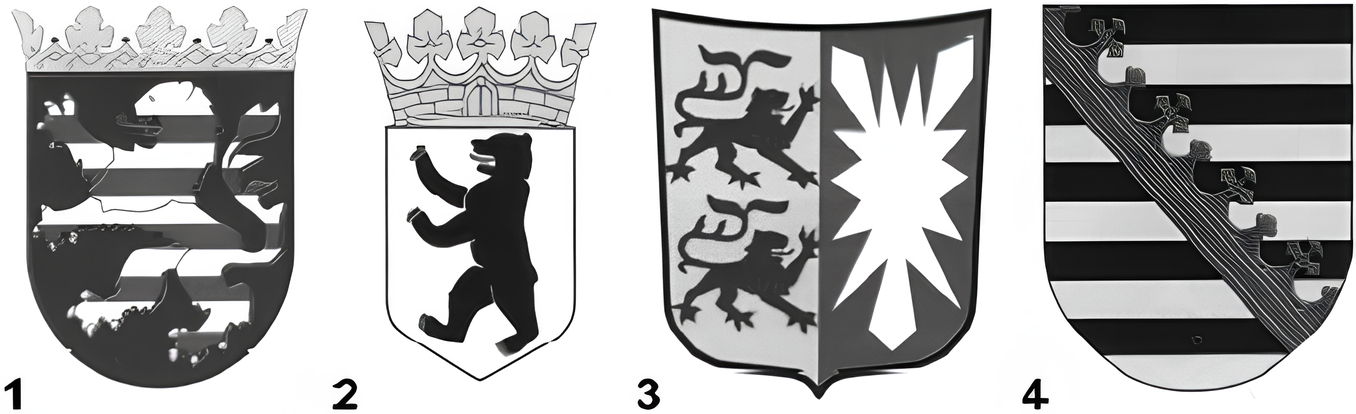
Correct answer: Picture 1
Hesse's coat of arms shows a lion striped red and silver nine times on a blue field, the so-called colourful lion of the Landgraves of Thuringia and Hesse. The design dates back to the Middle Ages.
-
Question 33Not answered
Which is a district in Hesse?
Correct answer: Main-Taunus district
The Main-Taunus district lies between Frankfurt and the Taunus mountains, with its seat in Hofheim, and is Germany's smallest rural district by area. Hesse has 21 rural districts and five independent cities in total.

-
Question 31Not answered
Which minister does Mecklenburg-Vorpommern not have?
Correct answer: Foreign Minister
Foreign policy is a federal responsibility, so Mecklenburg-Vorpommern, like all states, has no foreign minister. Its cabinet covers areas such as interior, finance, education, justice and agriculture.
-
Question 32Not answered
Which coat of arms belongs to the federal state of Mecklenburg-Vorpommern?
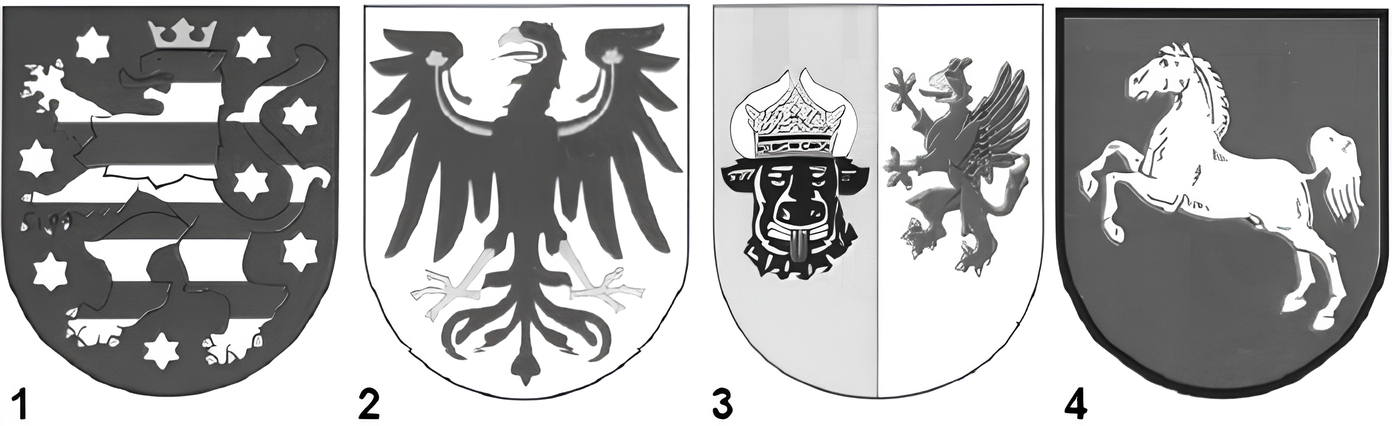
Correct answer: Picture 3
Mecklenburg-Vorpommern's coat of arms is quartered and combines the Mecklenburg bull's head, the Pomeranian griffin, the Brandenburg eagle and a second bull's head for Mecklenburg-Strelitz. It depicts the historic regions of the state.
-
Question 33Not answered
Which is a district in Mecklenburg-Vorpommern?
Correct answer: Mecklenburg Lake District
The Mecklenburg Lake District (Mecklenburgische Seenplatte) is Germany's largest rural district by area, in southern Mecklenburg-Vorpommern with its seat in Neubrandenburg. It is famous for its many lakes, including the Müritz.

-
Question 31Not answered
Which minister does Lower Saxony not have?
Correct answer: Foreign Minister
Foreign policy is a federal responsibility under the Basic Law, not a state matter. Lower Saxony therefore has no Foreign Minister; the Federal Foreign Office in Berlin handles diplomacy for all states.
-
Question 32Not answered
Which coat of arms belongs to the federal state of Lower Saxony?
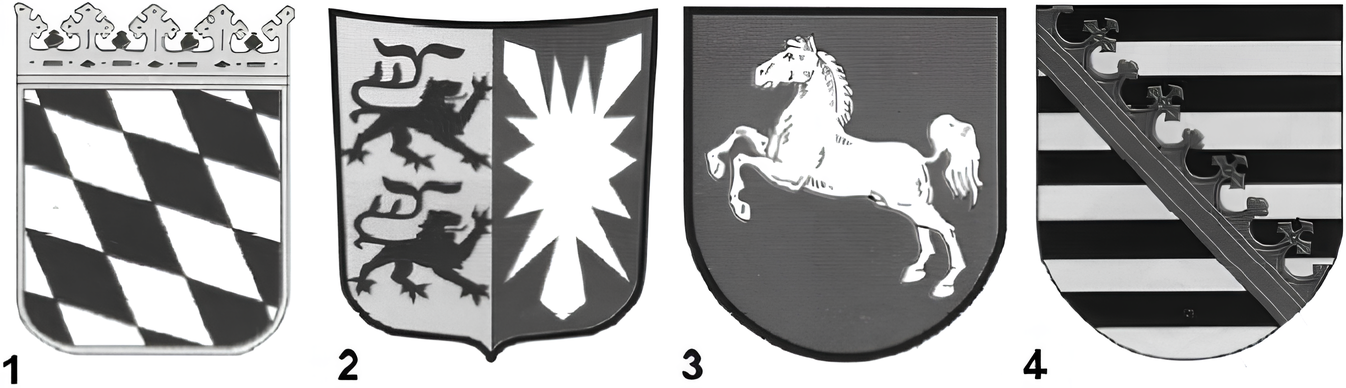
Correct answer: Picture 3
Lower Saxony bears the Saxon Steed: a white, leaping horse on a red field. The motif traces back to ancient Saxon tribal emblems and appears across several northern German regions.
-
Question 33Not answered
Which is a district in Lower Saxony?
Correct answer: Ammerland
Ammerland is a district in north-western Lower Saxony with its administrative seat in Westerstede. Part of the Oldenburg region, it is known for rhododendron cultivation and tree nurseries.

-
Question 31Not answered
Which minister does North Rhine-Westphalia not have?
Correct answer: Foreign Minister
Foreign policy is a federal matter, so North Rhine-Westphalia has no Foreign Minister. The Federal Foreign Office in Berlin is responsible; the state does, however, maintain its own representation to the federal government.
-
Question 32Not answered
Which coat of arms belongs to the federal state of North Rhine-Westphalia?
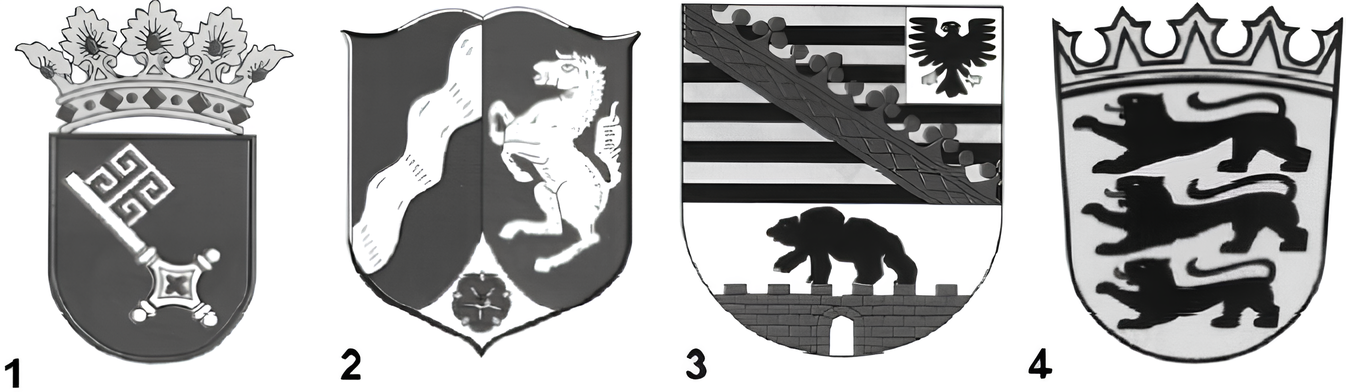
Correct answer: Picture 2
North Rhine-Westphalia's arms combine three symbols: the silver Rhine wave, the white Westphalian horse and the red Lippe rose. They represent the state's three historic regions of Rhineland, Westphalia and Lippe.
-
Question 33Not answered
Which is a district in North Rhine-Westphalia?
Correct answer: Rhine-Sieg district
The Rhine-Sieg district lies south of Bonn and almost completely surrounds that city. Its administrative seat is Siegburg; with over 600,000 inhabitants it is one of Germany's most populous districts.

-
Question 31Not answered
Which minister does Rhineland-Palatinate not have?
Correct answer: Foreign Minister
Foreign policy is a federal responsibility, so no state has a Foreign Minister. Rhineland-Palatinate does, however, maintain a state representation in Berlin and offices in Brussels.
-
Question 32Not answered
Which coat of arms belongs to the federal state of Rhineland-Palatinate?
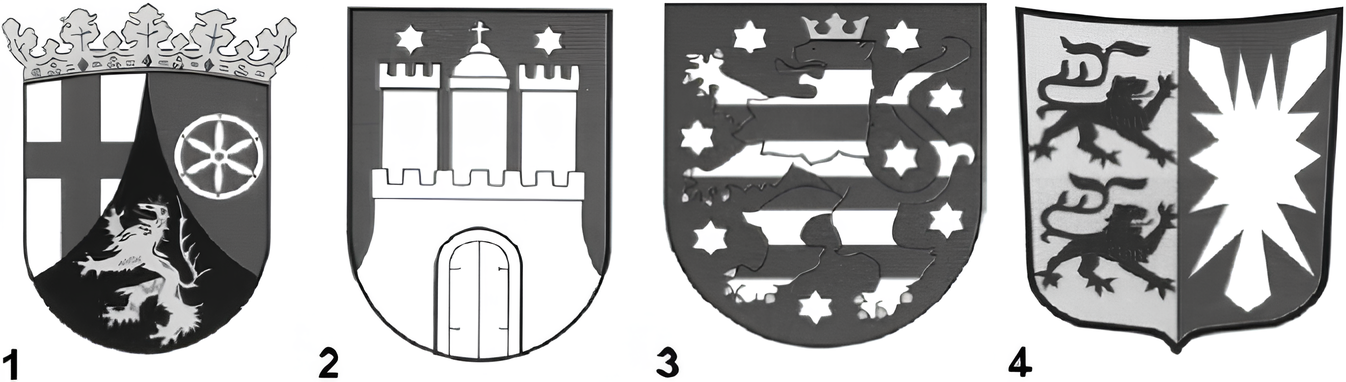
Correct answer: Picture 1
Rhineland-Palatinate bears the red Palatinate Lion on a gold field. The heraldic beast dates back to the Electoral Palatinate and unites the state's Palatine, Rhenish-Hessian and Trier regions.
-
Question 33Not answered
Which is a district in Rhineland-Palatinate?
Correct answer: Westerwald district
The Westerwald district in northern Rhineland-Palatinate has its seat in Montabaur. It lies within the namesake highlands between the Rhine, Lahn and Sieg rivers and belongs to the state's northern part.

-
Question 31Not answered
Which minister does Saarland not have?
Correct answer: Foreign Minister
Foreign policy is a federal competence, so Saarland has no Foreign Minister. Due to its proximity to France, it does maintain especially close cross-border ties through the SaarLorLux Greater Region.
-
Question 32Not answered
Which coat of arms belongs to the federal state of Saarland?
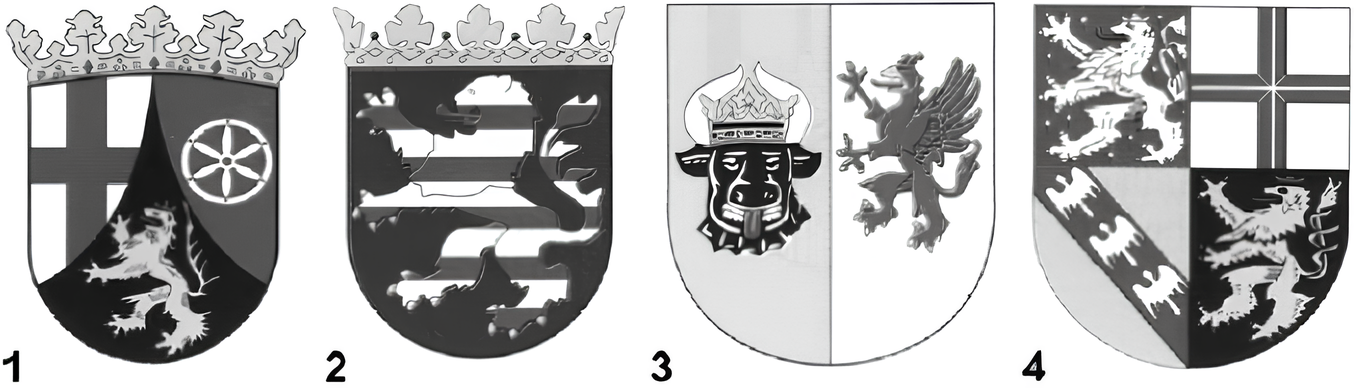
Correct answer: Picture 4
Saarland bears a quartered coat of arms with the emblems of Trier, the Electoral Palatinate, Nassau-Saarbrücken and Lorraine. The fields recall the region's historic territorial allegiances.
-
Question 33Not answered
Which is a district in Saarland?
Correct answer: Neunkirchen
Neunkirchen is one of Saarland's six districts, located east of Saarbrücken. Its eponymous capital was a centre of the Saarland iron and steel industry until the 1980s.

-
Question 31Not answered
Which minister does Saxony not have?
Correct answer: Foreign Minister
Foreign policy is exclusively a federal matter, so the Free State of Saxony has no Foreign Minister. The Federal Foreign Office in Berlin handles diplomacy.
-
Question 32Not answered
Which coat of arms belongs to the Free State of Saxony?
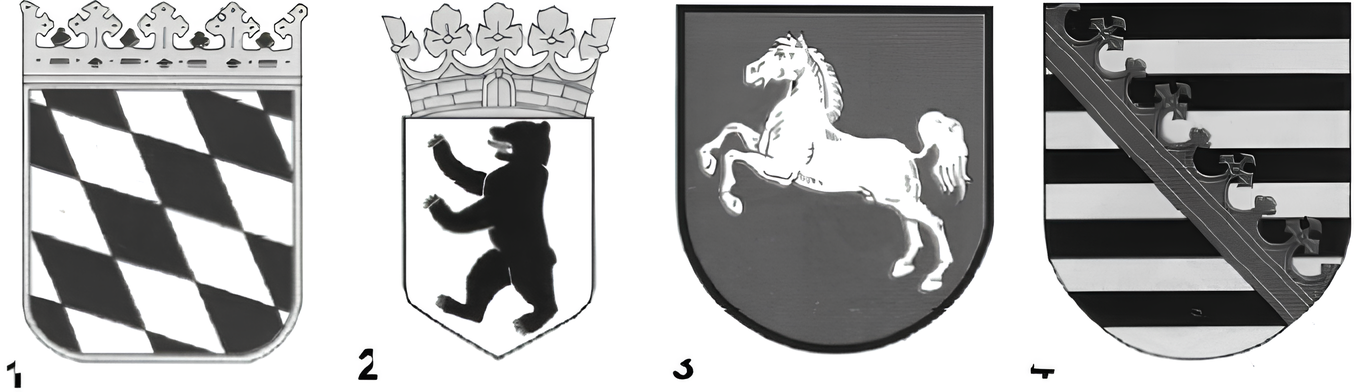
Correct answer: Picture 4
The Free State of Saxony's coat of arms shows black and gold horizontal bars overlaid with a diagonal green crown of rue. The design originates with the medieval House of Wettin.
-
Question 33Not answered
Which is a district in Saxony?
Correct answer: Vogtland district
The Vogtland district lies in south-western Saxony, bordering Thuringia, Bavaria and the Czech Republic. Its capital is Plauen, famed for Plauen lace.

-
Question 31Not answered
Which minister does Saxony-Anhalt not have?
Correct answer: Foreign Minister
Foreign policy rests with the federal government under the Basic Law, so Saxony-Anhalt has no Foreign Minister. The Federal Foreign Office in Berlin is responsible.
-
Question 32Not answered
Which coat of arms belongs to the federal state of Saxony-Anhalt?
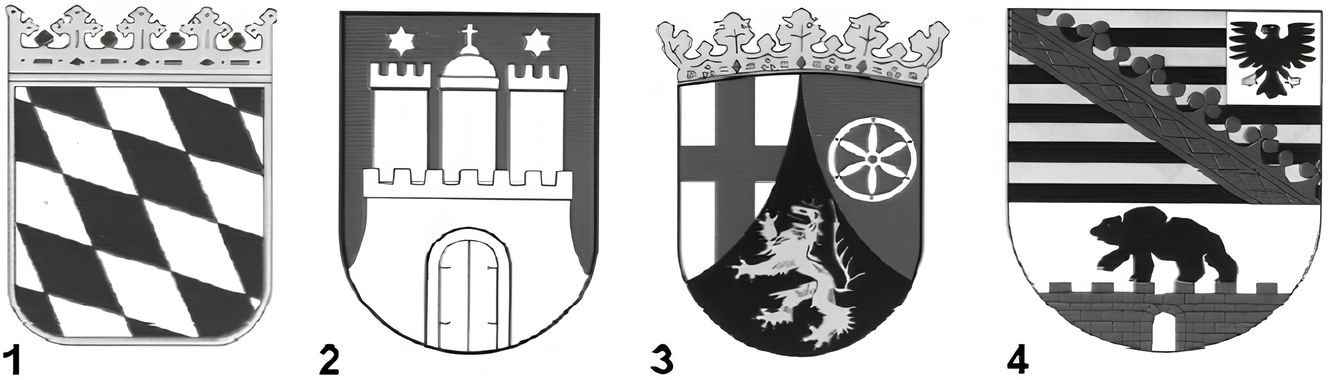
Correct answer: Picture 4
Saxony-Anhalt's arms show the black Ascanian bear on a red shield together with black-gold striped and rue-bedecked fields. They combine the emblems of Anhalt and the former Prussian Province of Saxony.
-
Question 33Not answered
Which is a district in Saxony-Anhalt?
Correct answer: Börde
Börde district in western Saxony-Anhalt has its administrative seat in Haldensleben. The fertile Magdeburg Börde plain is one of Germany's most productive agricultural regions.

-
Question 31Not answered
Which minister does Schleswig-Holstein not have?
Correct answer: Foreign Minister
Foreign policy is a federal task, so Schleswig-Holstein has no Foreign Minister. Given its location, the state nevertheless maintains close ties with Denmark and the wider Baltic region.
-
Question 32Not answered
Which coat of arms belongs to the federal state of Schleswig-Holstein?
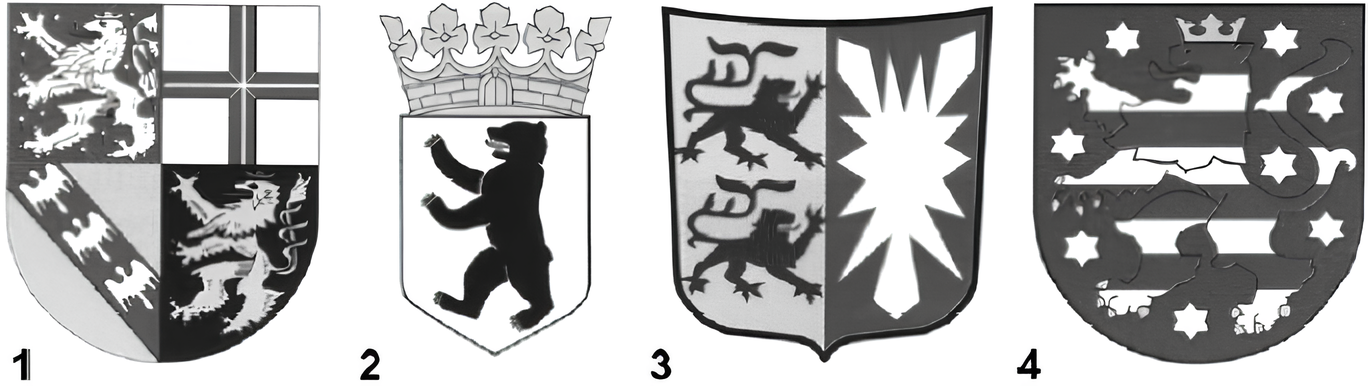
Correct answer: Picture 3
Schleswig-Holstein's coat of arms displays the two blue Schauenburg lions for Schleswig and the silver nettle leaf for Holstein. The design unites the two historic regions on one shield.
-
Question 33Not answered
Which is a district in Schleswig-Holstein?
Correct answer: North Friesland
Nordfriesland is Germany's north-westernmost district, including the North Frisian islands such as Sylt. Its capital is Husum, the birthplace of writer Theodor Storm.

-
Question 31Not answered
Which minister does Thuringia not have?
Correct answer: Foreign Minister
Foreign policy falls under the exclusive competence of the federal government, so Thuringia has no Foreign Minister. The Federal Foreign Office in Berlin handles such matters.
-
Question 32Not answered
Which coat of arms belongs to the Free State of Thuringia?
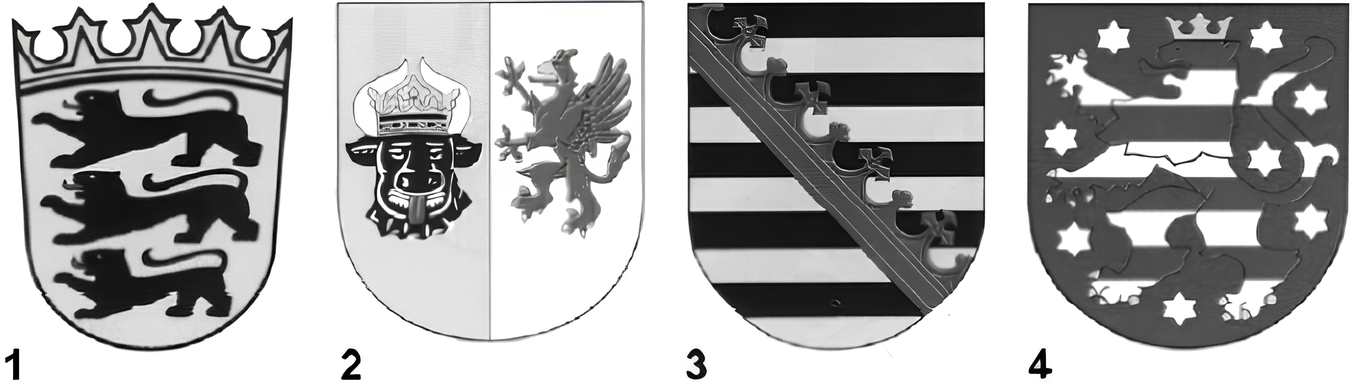
Correct answer: Picture 4
Thuringia's coat of arms shows a red lion with eight silver stars on a field of blue and silver bars. It originates with the historic Ludovingian lion and the Landgraves of Thuringia.
-
Question 33Not answered
Which is a district in Thuringia?
Correct answer: Wartburg district
The Wartburg district in western Thuringia is named after Wartburg Castle near Eisenach, where Martin Luther translated the New Testament in 1521-22. Its administrative seat is Bad Salzungen.

Your result
/ 33 correct
You pass with 17 or more correct answers.