Practice test 1
33 questions · 60 minutes · pass with 17
Answer every question, then tap Check results. Only then will you see which answers were right.
-
Question 1Not answered
What is the "5 % hurdle" in Germany?
Correct answer: Minimum percentage of votes to get into parliament
The 5 % hurdle is the minimum share of nationwide second votes a party must reach to enter the Bundestag. It is designed to prevent excessive fragmentation of parliament and to make stable governing majorities possible.
-
Question 2Not answered
Which symbol can be seen in the plenary chamber of the German Bundestag?
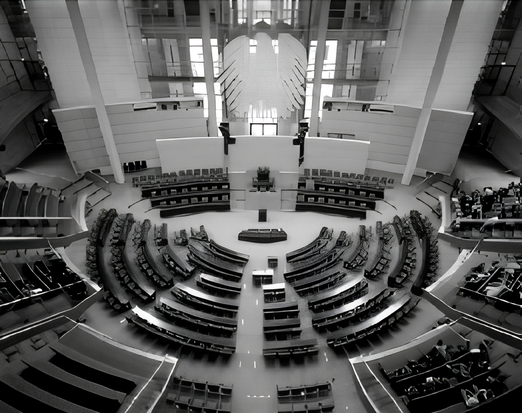
Correct answer: the federal eagle.
Behind the speaker's lectern in the plenary chamber of the Reichstag building hangs the federal eagle, the Federal Republic's heraldic animal. The current stylised form is based on Ludwig Gies's 1953 design.
-
Question 3Not answered
Why do you have to write down on your tax return in Germany whether you belong to a church or not? Because ...
Correct answer: there is a church tax that is linked to income and wage tax.
In Germany, church tax is collected by the tax office as a surcharge on income or wage tax. It amounts to 8 or 9 percent of the income tax and is paid only by members of a tax-entitled religious community.
-
Question 4Not answered
The "Third Reich" was a ...
Correct answer: dictatorship.
The "Third Reich" of 1933–1945 was a totalitarian dictatorship under Adolf Hitler and the NSDAP. Democratic structures were destroyed, other parties banned, trade unions dissolved and political opponents persecuted, imprisoned or murdered.
-
Question 5Not answered
In Germany, the people elect ...
Correct answer: the Bundestag.
In Germany the people directly elect only the Bundestag (Article 38 of the Basic Law). The Federal President, Chancellor and government are not elected by the people but by the Bundestag or the Federal Convention.
-
Question 6Not answered
Who is known as the "Chancellor of German Unity"?
Correct answer: Helmut Kohl
Helmut Kohl (CDU) was Chancellor from 1982 to 1998 and politically delivered reunification in 1989/90. For his role in the GDR's accession on 3 October 1990, he is known as the Chancellor of Unity.
-
Question 7Not answered
Mrs Seger is having a child. What does she have to do to receive parental allowance?
Correct answer: She has to submit an application to the parental allowance office.
Parental allowance must be applied for in writing at the responsible Elterngeldstelle in the federal state; there is no automatic payment. The application should be filed within the child's first three months, as back-payment is limited to three months.
-
Question 8Not answered
In which year did the National Socialists destroy synagogues and Jewish businesses in Germany?
Correct answer: 1938
During the night of 9 to 10 November 1938, known as the November Pogrom or Kristallnacht, National Socialists and their followers destroyed synagogues, Jewish shops and homes across the Reich. Over 400 Jews were killed or driven to their deaths.
-
Question 9Not answered
You would like to terminate your employment with a company in Germany. What do you have to consider?
Correct answer: the notice period
An ordinary resignation must observe the notice period – generally four weeks to the 15th or end of the month under §622 BGB, often longer in collective or individual contracts. The notice itself must be in writing.
-
Question 10Not answered
What is a custom in Germany at Christmas?
Correct answer: decorating a Christmas tree
Decorating a fir tree with candles and baubles has been the central Christmas custom in Germany since the 19th century. The tree is usually put up on 24 December and stays until Epiphany, 6 January.
-
Question 11Not answered
If you hit a child in Germany, ...
Correct answer: you can be punished for it.
Since 2000, §1631(2) BGB has guaranteed children the right to a non-violent upbringing; corporal punishment is forbidden. Striking a child can be prosecuted as bodily harm under §223 of the Criminal Code.
-
Question 12Not answered
When was the "economic miracle" in the Federal Republic of Germany?
Correct answer: 50s
The "economic miracle" (Wirtschaftswunder) refers to West Germany's rapid economic recovery in the 1950s. After the 1948 currency reform, Marshall Plan aid and Ludwig Erhard's social market economy delivered full employment and rising prosperity.
-
Question 13Not answered
What is not state authority in Germany?
Correct answer: Press
The three branches of state power are the legislature (lawmaking), the executive (administration) and the judiciary (courts). The press is often called the "fourth estate" but is not part of state power.
-
Question 14Not answered
What does the abbreviation EU mean?
Correct answer: European Union
EU stands for European Union, a union of currently 27 European states. It emerged from the European Community with the 1993 Treaty of Maastricht.
-
Question 15Not answered
If you are allowed to vote in a federal election in Germany, does that mean ...
Correct answer: active right to vote.
Being entitled to cast a vote is called the active right to vote. For Bundestag elections it applies to all German citizens aged 18 and over (Article 38(2) of the Basic Law); the right to stand as a candidate, the passive right, also starts at 18.
-
Question 16Not answered
In Germany, a change of government in a federal state can have an impact on federal politics. Governing becomes ...
Correct answer: more difficult if it changes the majority in the Bundesrat.
Through the Bundesrat the state governments take part in federal legislation. If a state election shifts the majorities in the Bundesrat, the federal government can be blocked on laws requiring its consent, which often shapes federal policy debates.
-
Question 17Not answered
What is the name of the current Chancellor of Germany?
Correct answer: Friedrich Merz
Friedrich Merz (CDU) was elected Federal Chancellor by the Bundestag on 6 May 2025, succeeding Olaf Scholz. He leads a black-red coalition government of the CDU/CSU and the SPD.
-
Question 18Not answered
At what age is one of legal age in Germany?
Correct answer: 18
In Germany, the age of majority is reached on the 18th birthday (§2 BGB). The person then gains full legal capacity and the right to vote in federal elections.
-
Question 19Not answered
Who decides whether a child goes to kindergarten in Germany?
Correct answer: the parents/guardians
Attending kindergarten in Germany is voluntary; the decision lies solely with the parents or legal guardians. Compulsory schooling only begins with the start of primary school.
-
Question 20Not answered
What should you do if you are treated badly by your contact person in a German authority?
Correct answer: I can complain to the head of the authority.
Public authorities are bound by an internal chain of command: anyone who feels mistreated can file a service complaint with the head of the authority. The complaint is informal, free of charge and reviewed internally.
-
Question 21Not answered
What did Willy Brandt want to express by kneeling in the former Jewish ghetto in Warsaw in 1970?
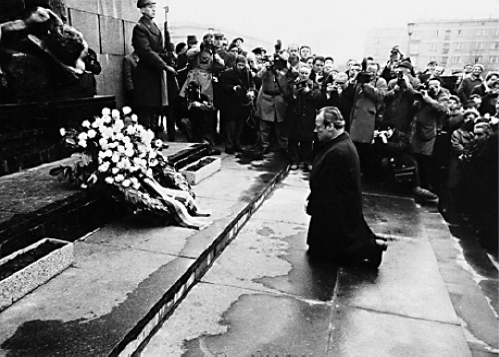
Correct answer: He asked Poland and the Polish Jews for forgiveness.
By kneeling on 7 December 1970 in front of the Warsaw Ghetto Memorial, Chancellor Willy Brandt symbolically asked Poland and Polish Jews for forgiveness for German crimes in the Second World War. The gesture became a milestone of reconciliation politics.
-
Question 22Not answered
Who appoints the ministers of the Federal Government in Germany?
Correct answer: the Federal President
Federal ministers are appointed and dismissed by the Federal President on the proposal of the Chancellor (Article 64). The President's role here is largely formal and reviews legality rather than political content.
-
Question 23Not answered
Who is mainly responsible for raising children in Germany?
Correct answer: the parents
Responsibility for raising children lies primarily with the parents under Article 6 of the Basic Law. The state oversees how this right is exercised and offers support through youth welfare and schools.
-
Question 24Not answered
Who elects the Federal President in Germany?
Correct answer: the Federal Assembly
The Federal President is elected by the Federal Convention (Bundesversammlung) under Article 54. It convenes solely for this purpose and consists of all Bundestag members plus an equal number of delegates sent by the state parliaments.
-
Question 25Not answered
Germany is a constitutional state. What does this mean?
Correct answer: All residents and the state must abide by the law.
Under the rule of law every state organ and every resident is bound by the law; nobody stands above it. This principle is enshrined in Article 20(3) of the Basic Law, which binds all state power to the constitution and the law.
-
Question 26Not answered
When does the legal night's rest begin in Germany?
Correct answer: at 10 pm
Statutory night-time quiet hours run from 10 pm to 6 am; noise must be kept at room volume and special consideration is required. The exact rules are laid down in the Federal Immission Control Act and local noise ordinances.
-
Question 27Not answered
Who is usually elected President of the German Bundestag?
Correct answer: a member of parliament from the largest parliamentary group
By parliamentary tradition the largest parliamentary group nominates the President of the Bundestag. He or she is elected in the constituent session and chairs the sittings and the Bundestag's administration (Article 40).
-
Question 28Not answered
What is the main task of the German Federal President? He / She ...
Correct answer: represents the country.
The Federal President's main role is representative: he represents Germany at home and abroad, signs laws into force and appoints ministers, judges and civil servants. Day-to-day political decisions are made by the Federal Government.
-
Question 29Not answered
In a Bundestag election in Germany, anyone may vote who ...
Correct answer: is a citizen of the Federal Republic of Germany and is at least 18 years old.
To vote in a Bundestag election you must hold German citizenship and be at least 18 on election day (Article 38(2) of the Basic Law and Section 12 BWG). Foreign nationals cannot vote federally; EU citizens may vote only in local and European elections.
-
Question 30Not answered
What did not exist in Germany during the Nazi era?
Correct answer: free elections
Under National Socialism there were no longer any free elections. After the Enabling Act of March 1933 all other parties were banned or dissolved, and only sham single-list NSDAP ballots took place.


-
Question 31Not answered
Which coat of arms belongs to the federal state of Baden-Württemberg?
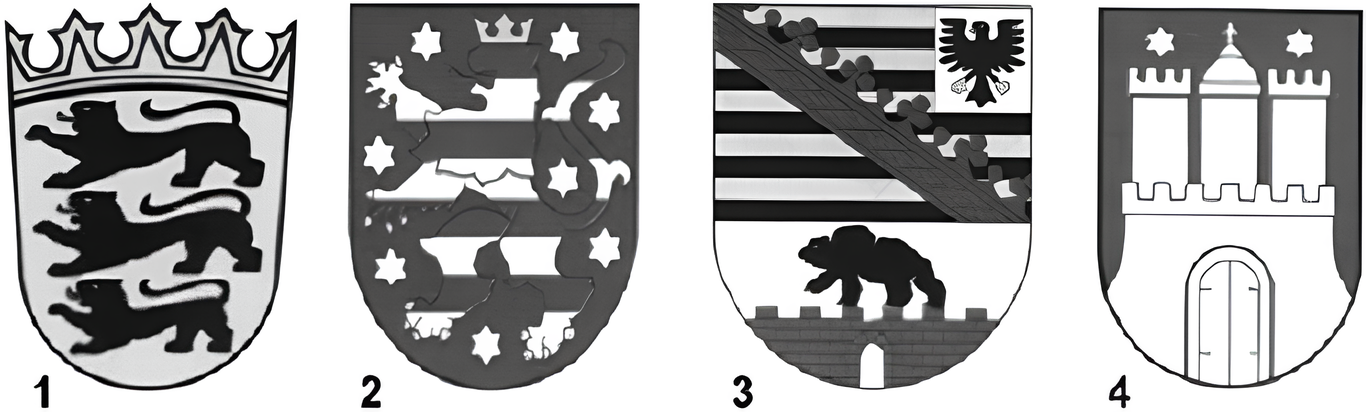
Correct answer: Picture 1
Baden-Württemberg's coat of arms shows three black walking lions on a gold field, derived from the Staufer Duchy of Swabia. The current design dates back to the state's founding in 1952.
-
Question 32Not answered
Which is a district in Baden-Württemberg?
Correct answer: Neckar-Odenwald district
The Neckar-Odenwald district lies in north-eastern Baden-Württemberg with its administrative seat in Mosbach and is one of the state's 35 rural districts. It was created in the 1973 district reform by merging the former Buchen and Mosbach districts.
-
Question 33Not answered
For how many years is the state parliament in Baden-Württemberg elected?
Correct answer: 5
The Baden-Württemberg state parliament is elected for five years, as in most German territorial states. It sits in Stuttgart and usually has between 120 and 154 members.

-
Question 31Not answered
Which coat of arms belongs to the Free State of Bavaria?
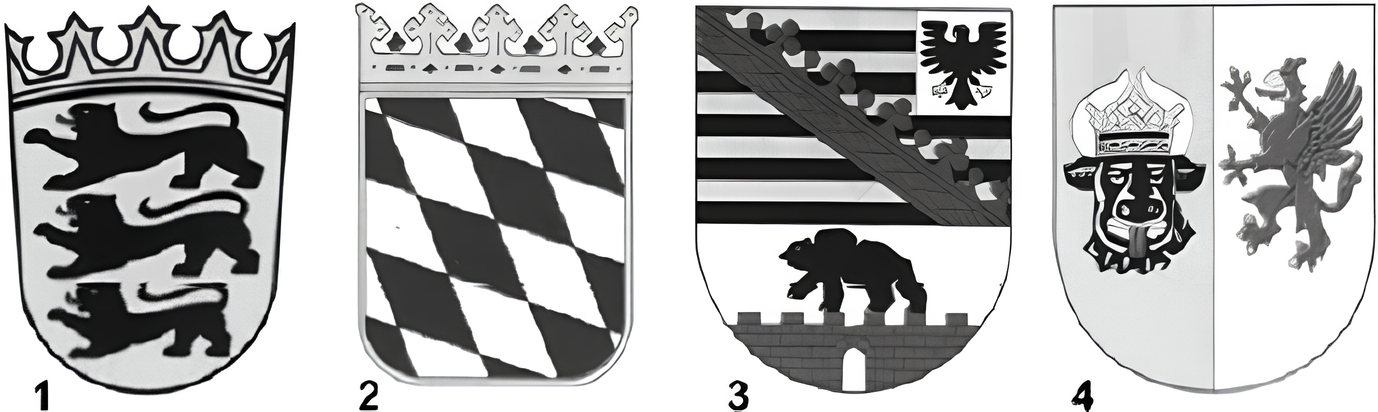
Correct answer: Picture 2
Bavaria's large state coat of arms features the famous white-and-blue lozenges of the Wittelsbachs in its inescutcheon, alongside fields with the Palatinate lion, the Franconian rake and the Veldenz lion. Bavaria officially holds the title Free State.
-
Question 32Not answered
Which is a district in Bavaria?
Correct answer: Altötting
Altötting is a rural district in Upper Bavaria with its seat in Altötting town, famous as a major Catholic pilgrimage site with the Chapel of the Black Madonna. Bavaria has 71 rural districts in total.
-
Question 33Not answered
For how many years is the state parliament in Bavaria elected?
Correct answer: 5
The Bavarian state parliament is elected for five years; this term has applied since 1998, having previously been four. It meets at the Maximilianeum in Munich and usually has about 180 members.

-
Question 31Not answered
Which coat of arms belongs to the federal state of Berlin?
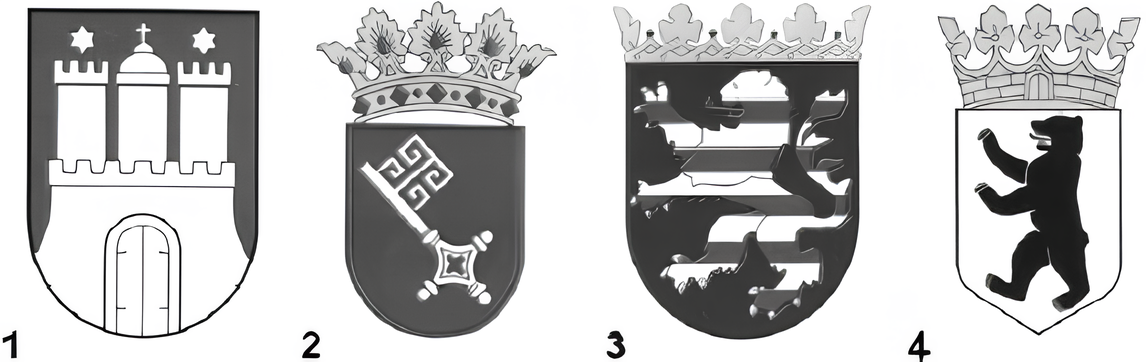
Correct answer: Picture 4
Berlin's coat of arms shows an upright black bear on a white shield, topped with a golden mural crown. The Berlin bear has been the city's emblem since the 13th century.
-
Question 32Not answered
Which is a district of Berlin?
Correct answer: Pankow
Pankow is one of Berlin's twelve boroughs, lying in the north-east with about 410,000 residents. Berlin's boroughs handle municipal tasks that elsewhere fall to towns and municipalities.
-
Question 33Not answered
For how many years is the state parliament in Berlin elected?
Correct answer: 5
Berlin's House of Representatives is elected for five years and serves as the state parliament of the city-state. It meets in the historic Prussian Landtag building on Niederkirchnerstrasse.

-
Question 31Not answered
Which coat of arms belongs to the federal state of Brandenburg?
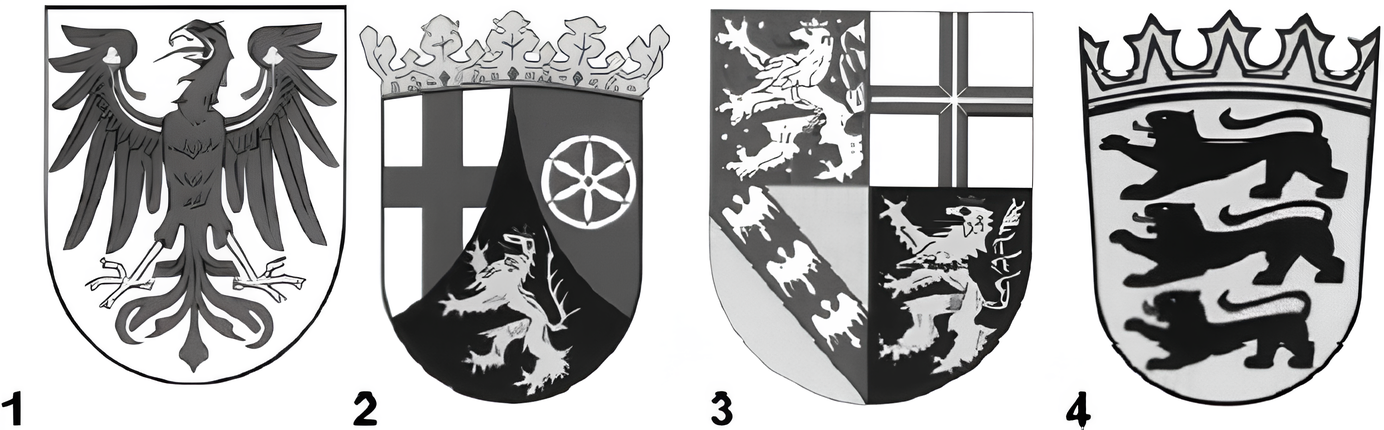
Correct answer: Picture 1
Brandenburg's coat of arms shows a red eagle with golden talons on a white shield. The Brandenburg eagle dates back to the Margraves of Brandenburg in the 12th century.
-
Question 32Not answered
Which is a district in Brandenburg?
Correct answer: Prignitz
Prignitz is a rural district in north-western Brandenburg with its seat in Perleberg. Brandenburg is divided into 14 rural districts and four independent cities surrounding the capital Potsdam.
-
Question 33Not answered
For how many years is the state parliament in Brandenburg elected?
Correct answer: 5
The Brandenburg state parliament is elected for five years and meets in the reconstructed City Palace in Potsdam. It usually consists of 88 members.

-
Question 31Not answered
Which coat of arms belongs to the Free Hanseatic City of Bremen?
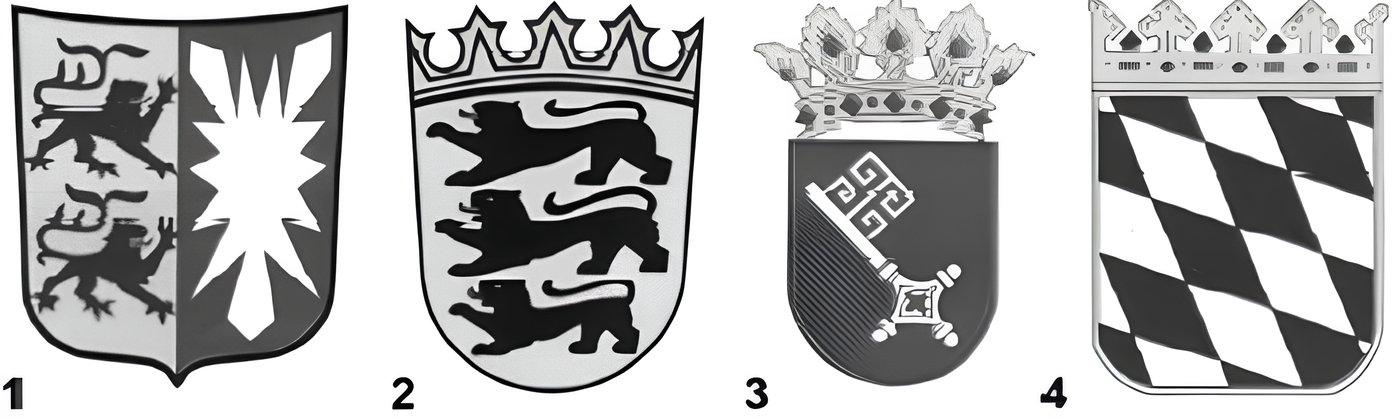
Correct answer: Picture 3
The arms of the Free Hanseatic City of Bremen show a silver key with the bit pointing upwards on a red field. The key refers to Saint Peter, patron of Bremen Cathedral.
-
Question 32Not answered
Which is a district of Bremen?
Correct answer: Hemelingen
Hemelingen is one of Bremen city's five boroughs, located in the south-east along the Weser river. The federal state of Bremen consists of the two cities of Bremen and Bremerhaven.
-
Question 33Not answered
For how many years is the state parliament in Bremen elected?
Correct answer: 4
The Bremen Citizens' Assembly, the state's parliament, is elected for four years. Bremen is one of the few German states that has kept a four-year rather than five-year term.

-
Question 31Not answered
Which coat of arms belongs to the Free and Hanseatic City of Hamburg?
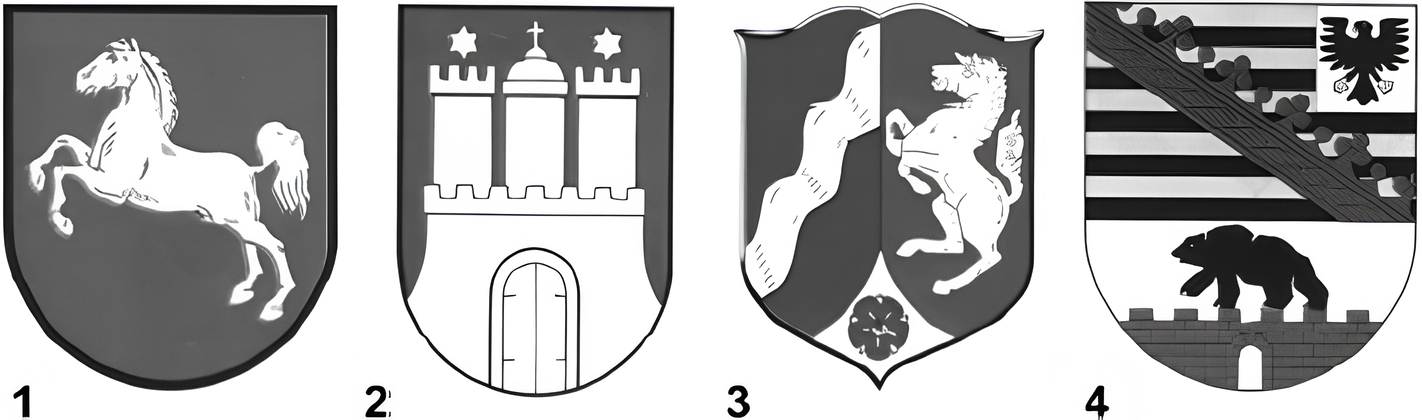
Correct answer: Picture 2
Hamburg's coat of arms shows a white castle with three towers on a red field, symbolising the Hanseatic city's independence. The cross on the central tower refers to the Church of St Mary.
-
Question 32Not answered
Which is a district of Hamburg?
Correct answer: Altona
Altona is one of Hamburg's seven boroughs, located in the west of the city along the Elbe river. Until 1937 Altona was an independent city belonging to Schleswig-Holstein.
-
Question 33Not answered
For how many years is the state parliament in Hamburg elected?
Correct answer: 5
The Hamburg Parliament (Bürgerschaft) is elected for five years. It meets in Hamburg's City Hall on the Rathausmarkt and has at least 121 members.

-
Question 31Not answered
Which coat of arms belongs to the federal state of Hesse?
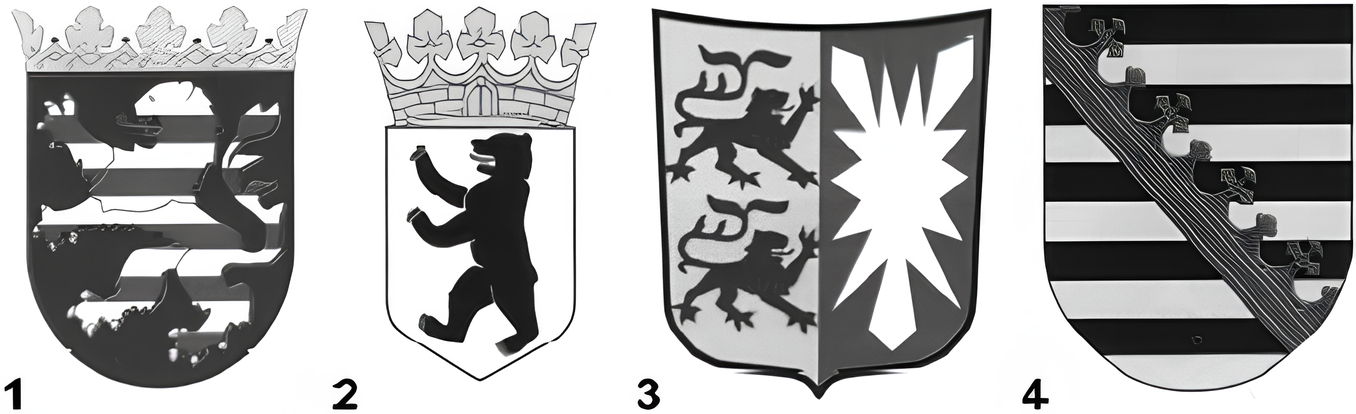
Correct answer: Picture 1
Hesse's coat of arms shows a lion striped red and silver nine times on a blue field, the so-called colourful lion of the Landgraves of Thuringia and Hesse. The design dates back to the Middle Ages.
-
Question 32Not answered
Which is a district in Hesse?
Correct answer: Main-Taunus district
The Main-Taunus district lies between Frankfurt and the Taunus mountains, with its seat in Hofheim, and is Germany's smallest rural district by area. Hesse has 21 rural districts and five independent cities in total.
-
Question 33Not answered
For how many years is the state parliament in Hesse elected?
Correct answer: 5
The Hessian state parliament is elected for five years and meets in the City Palace in Wiesbaden. It usually has between 110 and 137 members.

-
Question 31Not answered
Which coat of arms belongs to the federal state of Mecklenburg-Vorpommern?
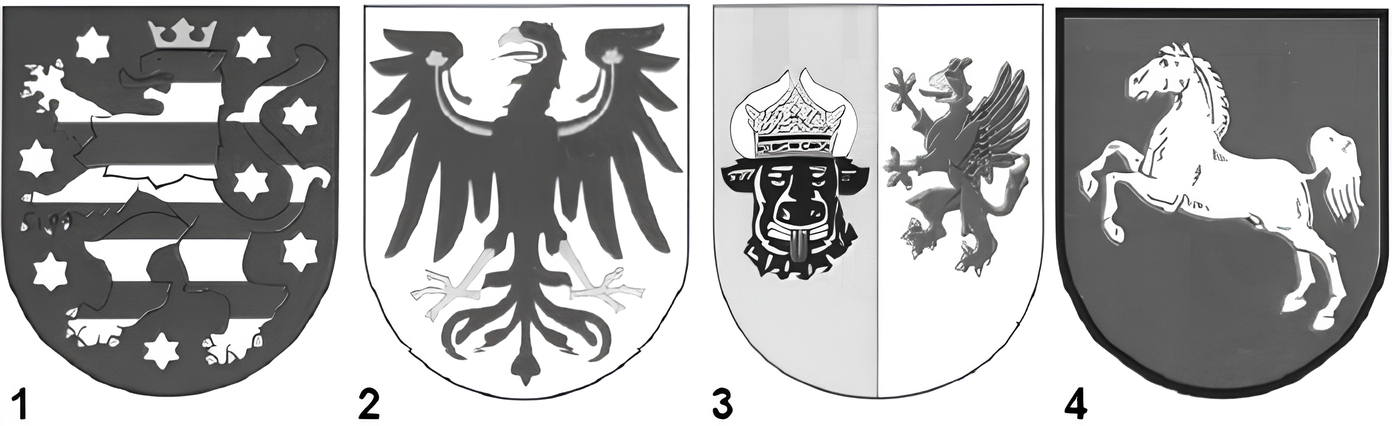
Correct answer: Picture 3
Mecklenburg-Vorpommern's coat of arms is quartered and combines the Mecklenburg bull's head, the Pomeranian griffin, the Brandenburg eagle and a second bull's head for Mecklenburg-Strelitz. It depicts the historic regions of the state.
-
Question 32Not answered
Which is a district in Mecklenburg-Vorpommern?
Correct answer: Mecklenburg Lake District
The Mecklenburg Lake District (Mecklenburgische Seenplatte) is Germany's largest rural district by area, in southern Mecklenburg-Vorpommern with its seat in Neubrandenburg. It is famous for its many lakes, including the Müritz.
-
Question 33Not answered
For how many years is the state parliament in Mecklenburg-Vorpommern elected?
Correct answer: 5
The Mecklenburg-Vorpommern state parliament is elected for five years and meets in Schwerin Castle. It usually has 71 members.

-
Question 31Not answered
Which coat of arms belongs to the federal state of Lower Saxony?
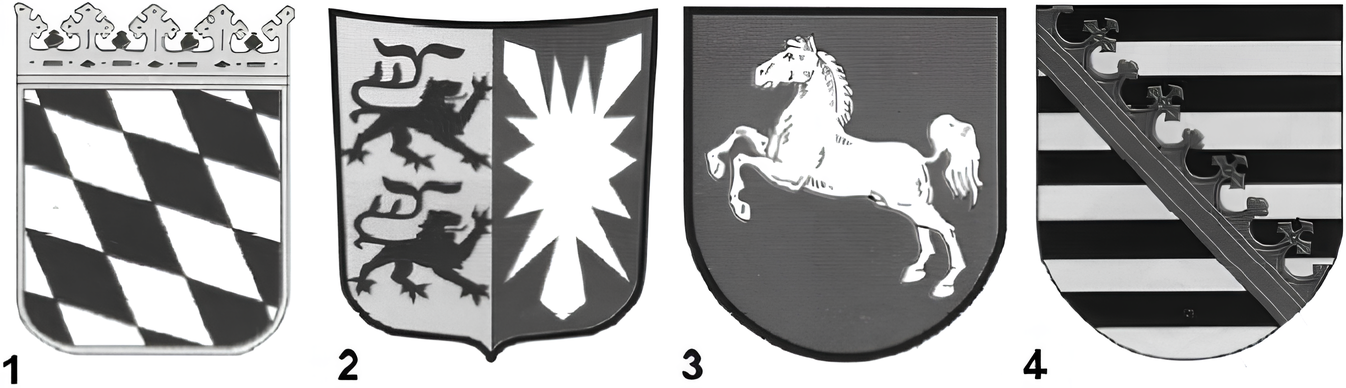
Correct answer: Picture 3
Lower Saxony bears the Saxon Steed: a white, leaping horse on a red field. The motif traces back to ancient Saxon tribal emblems and appears across several northern German regions.
-
Question 32Not answered
Which is a district in Lower Saxony?
Correct answer: Ammerland
Ammerland is a district in north-western Lower Saxony with its administrative seat in Westerstede. Part of the Oldenburg region, it is known for rhododendron cultivation and tree nurseries.
-
Question 33Not answered
For how many years is the state parliament in Lower Saxony elected?
Correct answer: 5
The Lower Saxon state parliament is elected for five years, as in nearly all German states. It sits in the Leineschloss in Hannover and elects the Minister-President.

-
Question 31Not answered
Which coat of arms belongs to the federal state of North Rhine-Westphalia?
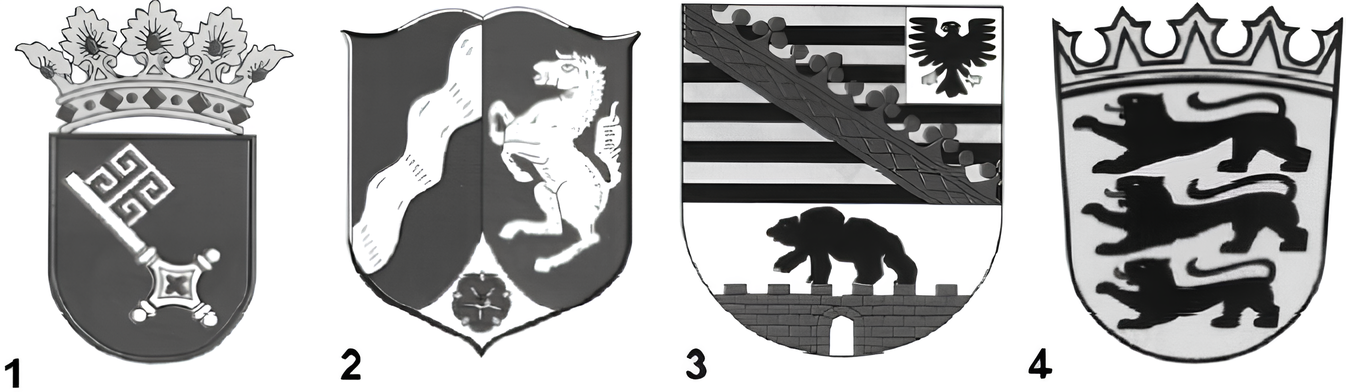
Correct answer: Picture 2
North Rhine-Westphalia's arms combine three symbols: the silver Rhine wave, the white Westphalian horse and the red Lippe rose. They represent the state's three historic regions of Rhineland, Westphalia and Lippe.
-
Question 32Not answered
Which is a district in North Rhine-Westphalia?
Correct answer: Rhine-Sieg district
The Rhine-Sieg district lies south of Bonn and almost completely surrounds that city. Its administrative seat is Siegburg; with over 600,000 inhabitants it is one of Germany's most populous districts.
-
Question 33Not answered
For how many years is the state parliament in North Rhine-Westphalia elected?
Correct answer: 5
North Rhine-Westphalia's state parliament is elected for five years and meets on the Rhine bank in Düsseldorf. With around 200 members, it is Germany's largest state legislature.

-
Question 31Not answered
Which coat of arms belongs to the federal state of Rhineland-Palatinate?
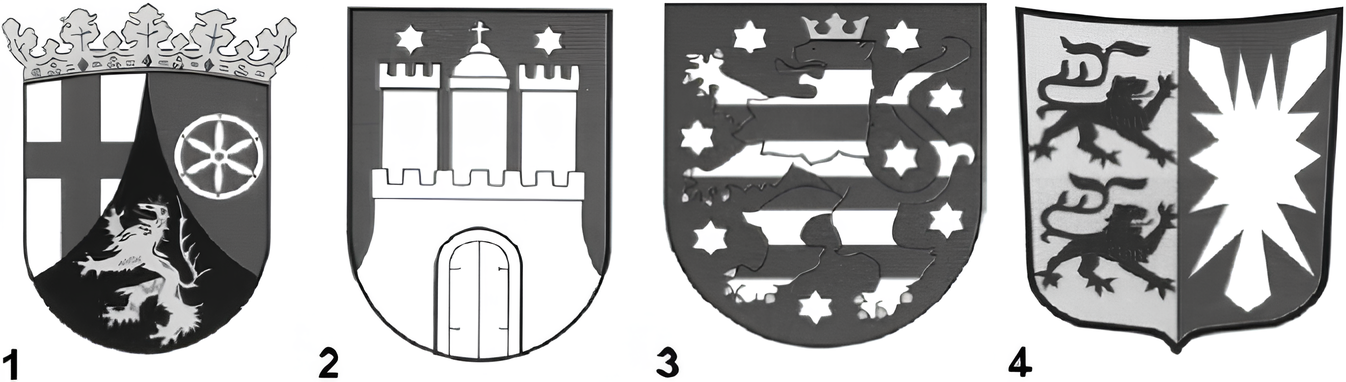
Correct answer: Picture 1
Rhineland-Palatinate bears the red Palatinate Lion on a gold field. The heraldic beast dates back to the Electoral Palatinate and unites the state's Palatine, Rhenish-Hessian and Trier regions.
-
Question 32Not answered
Which is a district in Rhineland-Palatinate?
Correct answer: Westerwald district
The Westerwald district in northern Rhineland-Palatinate has its seat in Montabaur. It lies within the namesake highlands between the Rhine, Lahn and Sieg rivers and belongs to the state's northern part.
-
Question 33Not answered
For how many years is the state parliament in Rhineland-Palatinate elected?
Correct answer: 5
The Rhineland-Palatinate state parliament is elected for five years. It meets in the Deutschhaus in Mainz, site of the 1793 Mainz Parliament, the oldest popularly elected assembly on German soil.

-
Question 31Not answered
Which coat of arms belongs to the federal state of Saarland?
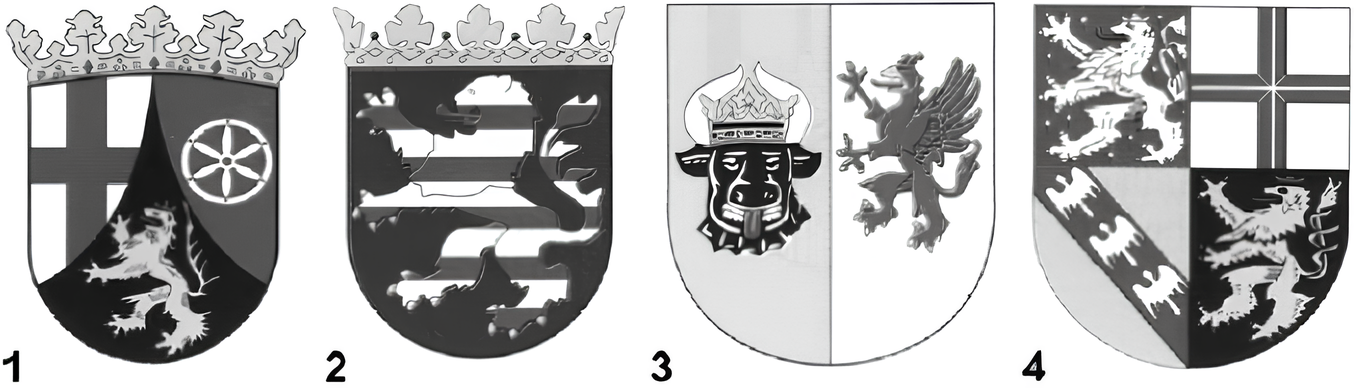
Correct answer: Picture 4
Saarland bears a quartered coat of arms with the emblems of Trier, the Electoral Palatinate, Nassau-Saarbrücken and Lorraine. The fields recall the region's historic territorial allegiances.
-
Question 32Not answered
Which is a district in Saarland?
Correct answer: Neunkirchen
Neunkirchen is one of Saarland's six districts, located east of Saarbrücken. Its eponymous capital was a centre of the Saarland iron and steel industry until the 1980s.
-
Question 33Not answered
For how many years is the Saarland state parliament elected?
Correct answer: 5
The Saarland state parliament is elected for five years and meets in Saarbrücken. With 51 members it is the smallest parliament of any German territorial state.

-
Question 31Not answered
Which coat of arms belongs to the Free State of Saxony?
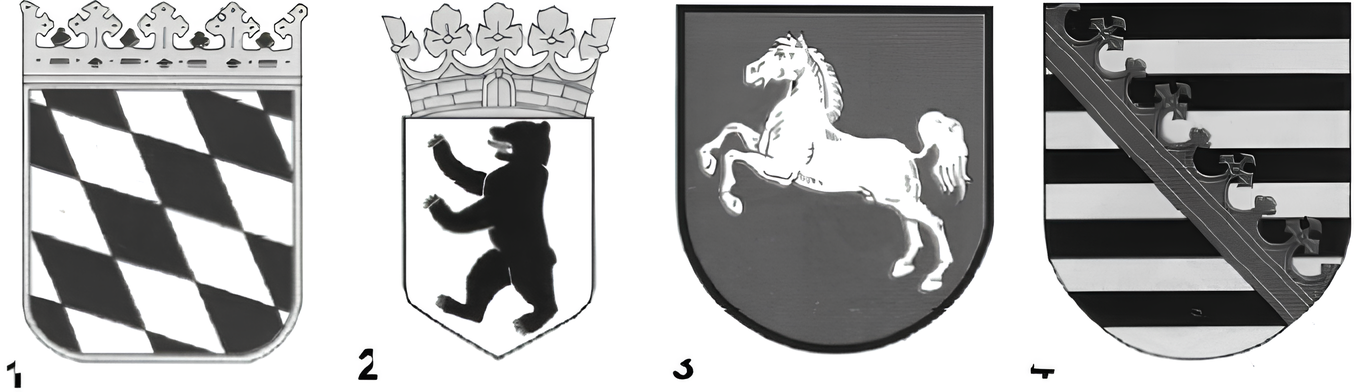
Correct answer: Picture 4
The Free State of Saxony's coat of arms shows black and gold horizontal bars overlaid with a diagonal green crown of rue. The design originates with the medieval House of Wettin.
-
Question 32Not answered
Which is a district in Saxony?
Correct answer: Vogtland district
The Vogtland district lies in south-western Saxony, bordering Thuringia, Bavaria and the Czech Republic. Its capital is Plauen, famed for Plauen lace.
-
Question 33Not answered
For how many years is the state parliament in Saxony elected?
Correct answer: 5
The Saxon state parliament is elected for five years and meets in a modern building on the Elbe in Dresden. It elects the Minister-President and oversees the state government.

-
Question 31Not answered
Which coat of arms belongs to the federal state of Saxony-Anhalt?
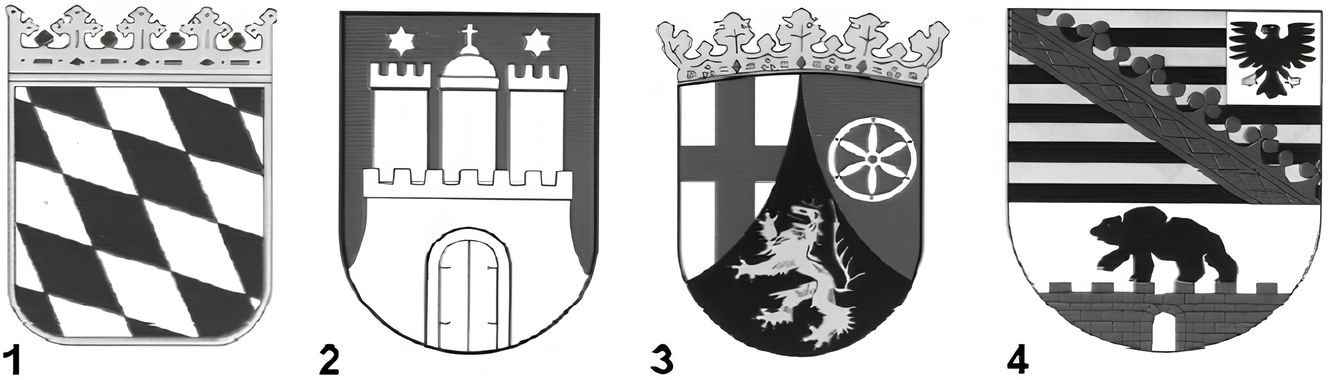
Correct answer: Picture 4
Saxony-Anhalt's arms show the black Ascanian bear on a red shield together with black-gold striped and rue-bedecked fields. They combine the emblems of Anhalt and the former Prussian Province of Saxony.
-
Question 32Not answered
Which is a district in Saxony-Anhalt?
Correct answer: Börde
Börde district in western Saxony-Anhalt has its administrative seat in Haldensleben. The fertile Magdeburg Börde plain is one of Germany's most productive agricultural regions.
-
Question 33Not answered
For how many years is the state parliament in Saxony-Anhalt elected?
Correct answer: 5
Saxony-Anhalt's state parliament is elected for five years and meets in Magdeburg. It comprises at least 83 members and elects the Minister-President.

-
Question 31Not answered
Which coat of arms belongs to the federal state of Schleswig-Holstein?
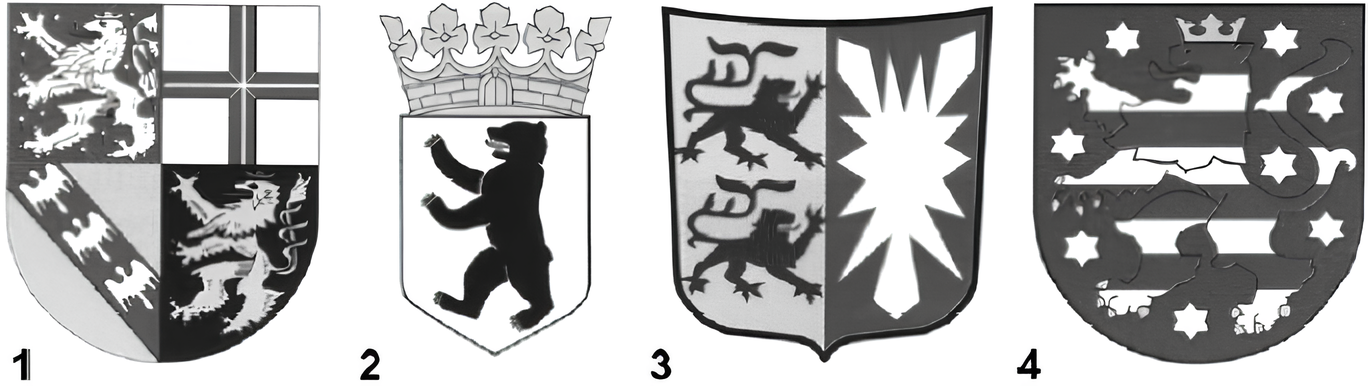
Correct answer: Picture 3
Schleswig-Holstein's coat of arms displays the two blue Schauenburg lions for Schleswig and the silver nettle leaf for Holstein. The design unites the two historic regions on one shield.
-
Question 32Not answered
Which is a district in Schleswig-Holstein?
Correct answer: North Friesland
Nordfriesland is Germany's north-westernmost district, including the North Frisian islands such as Sylt. Its capital is Husum, the birthplace of writer Theodor Storm.
-
Question 33Not answered
For how many years is the state parliament in Schleswig-Holstein elected?
Correct answer: 5
Schleswig-Holstein's state parliament is elected for five years and meets in Kiel. It elects the Minister-President and is the only German state legislature with guaranteed representation for the Danish minority.

-
Question 31Not answered
Which coat of arms belongs to the Free State of Thuringia?
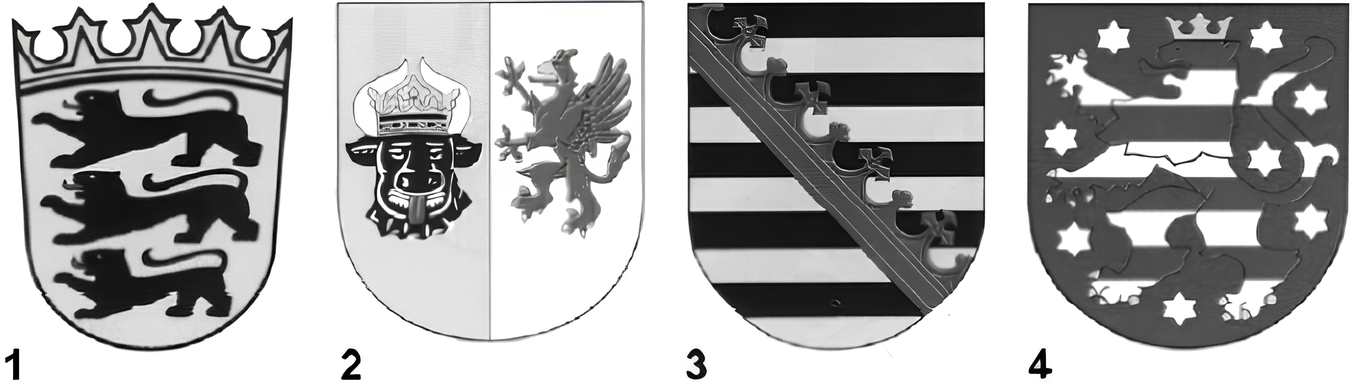
Correct answer: Picture 4
Thuringia's coat of arms shows a red lion with eight silver stars on a field of blue and silver bars. It originates with the historic Ludovingian lion and the Landgraves of Thuringia.
-
Question 32Not answered
Which is a district in Thuringia?
Correct answer: Wartburg district
The Wartburg district in western Thuringia is named after Wartburg Castle near Eisenach, where Martin Luther translated the New Testament in 1521-22. Its administrative seat is Bad Salzungen.
-
Question 33Not answered
For how many years is the state parliament in Thuringia elected?
Correct answer: 5
Thuringia's state parliament is elected for five years and meets in Erfurt. It elects the Minister-President and serves as the Free State's legislative body.

Your result
/ 33 correct
You pass with 17 or more correct answers.