Practice test 9
33 questions · 60 minutes · pass with 17
Answer every question, then tap Check results. Only then will you see which answers were right.
-
Question 1Not answered
Which war lasted from 1939 to 1945?
Correct answer: the Second World War
The Second World War lasted from 1939 to 1945. It began on 1 September 1939 with the German invasion of Poland and ended in Europe on 8 May 1945 with the unconditional surrender of the German Reich.
-
Question 2Not answered
When was the Berlin Wall opened to everyone?
Correct answer: 1989
The Berlin Wall was opened to everyone on 9 November 1989 after SED official Günter Schabowski unexpectedly announced free travel at a press conference. The division of Germany was de-facto over; reunification followed on 3 October 1990.
-
Question 3Not answered
Who is the head of state of the Federal Republic of Germany?
Correct answer: the Federal President
The head of state of the Federal Republic of Germany is the Federal President. He performs mainly representative functions, signs laws into force and ranks above the Chancellor in protocol, while the Chancellor leads the actual government business.
-
Question 4Not answered
What is allowed in federal and state elections in Germany?
Correct answer: You can vote by post.
In federal and state elections every eligible voter may cast their vote by post. You request the postal-voting documents from the municipality, mark the ballot at home and return it in good time before election day.
-
Question 5Not answered
What is not part of the executive in Germany?
Correct answer: the courts
Courts belong to the judiciary, the third branch of state power, which interprets the law independently. The executive, by contrast, comprises the federal government, the administration and the police – the organs that implement the laws.
-
Question 6Not answered
On what legal basis was the State of Israel founded?
Correct answer: a resolution of the United Nations
The State of Israel was founded on 14 May 1948 on the basis of the United Nations Partition Plan for Palestine (Resolution 181 of 1947). The UN General Assembly had decided to create a Jewish and an Arab state in the territory.
-
Question 7Not answered
What do you pay automatically in Germany if you are permanently employed?
Correct answer: Social security
Anyone in permanent employment automatically pays social security contributions covering health, pension, unemployment and long-term care insurance. They are deducted directly from gross pay, with employees and employers each bearing about half.
-
Question 8Not answered
What is not written in the Basic Law of Germany?
Correct answer: Everyone should have the same amount of money.
The Basic Law guarantees freedom, dignity and equality before the law, but not equality of wealth. A duty to share income equally would conflict with the freedom to choose a profession (Art. 12) and the right to property (Art. 14).
-
Question 9Not answered
The German federal states participate in federal legislation through ...
Correct answer: the Bundesrat.
The federal states participate in federal legislation through the Bundesrat (Article 50). For laws that affect their interests or administration, the Bundesrat's consent is required (the so-called Zustimmungsgesetze).
-
Question 10Not answered
In Germany, a mayor is ...
Correct answer: the head of a municipality.
The mayor is the political head of a municipality and leads its administration. In most German states the mayor is elected directly by the citizens and also chairs the municipal council.
-
Question 11Not answered
A man in a wheelchair has applied for a job as an accountant. What is an example of discrimination? He does not get the job only because he ...
Correct answer: is in a wheelchair.
Refusing to hire someone solely because of a disability is discrimination under the General Equal Treatment Act (§1, §7 AGG). For a professionally qualified person, the employer must consider reasonable adjustments.
-
Question 12Not answered
Which countries were referred to as "Allied occupying powers" in Germany after the Second World War?
Correct answer: USA, Soviet Union, Great Britain, France
After the Second World War Germany was occupied by the four victorious powers: the USA, the Soviet Union, Great Britain and France. They took over supreme governmental authority in 1945 and divided the country into four occupation zones.
-
Question 13Not answered
They want to abolish the bus line that you always take to work. What can you do to preserve the bus route?
Correct answer: I can take part in a citizens' initiative to preserve the bus route or set up an initiative myself.
Anyone who wants to push back against a local decision can join or found a citizens' initiative. This way petitions can be organised, politicians lobbied and formal Bürgerbegehren launched – a classic tool of grass-roots democratic participation.
-
Question 14Not answered
In Germany, the Bundestag and the Bundesrat belong to the ...
Correct answer: Legislative.
The Bundestag and the Bundesrat together form the legislature, the lawmaking branch of the federation. The executive (Federal Government) implements laws and the judiciary (courts) interprets them; this separation of powers guards against abuse of power.
-
Question 15Not answered
From 1961 to 1989 Berlin was ...
Correct answer: divided by a wall.
From 13 August 1961 until 9 November 1989 Berlin was divided by the Wall. It encircled West Berlin over about 155 km and was built to prevent GDR citizens from fleeing to the West.
-
Question 16Not answered
How many federal states were added to the Federal Republic of Germany at reunification in 1990?
Correct answer: 5
On 3 October 1990, five new federal states joined the Federal Republic: Brandenburg, Mecklenburg-Western Pomerania, Saxony, Saxony-Anhalt and Thuringia. East and West Berlin were merged into a single state.
-
Question 17Not answered
What are the colours of the German flag?
Correct answer: black-red-gold
The German federal flag has three horizontal stripes in black, red and gold. These colours date back to the Wars of Liberation against Napoleon and were enshrined in Article 22 of the Basic Law in 1949.
-
Question 18Not answered
The parliamentary opposition in the German Bundestag ...
Correct answer: scrutinises the government.
The opposition scrutinises the government, exposes wrongdoing and presents political alternatives. Its main tools are parliamentary questions, committees of inquiry and the right to introduce its own bills.
-
Question 19Not answered
What happened on 17 June 1953 in the GDR?
Correct answer: nationwide strikes and a popular uprising
On 17 June 1953, hundreds of thousands of workers in the GDR struck against raised work quotas; the protest quickly grew into a nationwide uprising. Soviet tanks crushed it, and the date served as West Germany's national holiday until 1990.
-
Question 20Not answered
What is the Bundeswehr?
Correct answer: the German army
The Bundeswehr is the armed forces of the Federal Republic of Germany. It was established in 1955 and in peacetime is subordinate to the Defence Minister, passing to the Chancellor in case of defence (Articles 65a, 115b).
-
Question 21Not answered
How often are there usually federal elections in Germany?
Correct answer: every four years
Article 39 of the Basic Law sets the Bundestag's term at four years, so federal elections are normally held every four years. Early elections happen only if parliament is dissolved, as in 2005 after Chancellor Schröder lost a vote of confidence.
-
Question 22Not answered
French President François Mitterrand and German Chancellor Helmut Kohl commemorate the dead of both world wars together in Verdun. Which objective of the European Union is emphasised at this meeting?
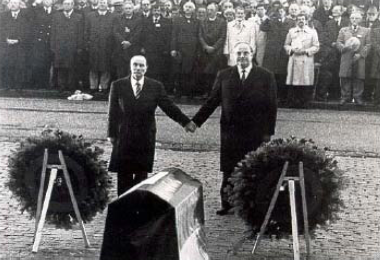
Correct answer: Peace and security in the countries of the EU
The 1984 gesture by Mitterrand and Kohl on the Verdun battlefields symbolises the EU's core aim: lasting peace and security in Europe after two world wars. Franco-German reconciliation is regarded as the engine of European integration.
-
Question 23Not answered
Why is there a 5% threshold in the electoral law of the Federal Republic of Germany? It exists because ...
Correct answer: many small parties make it difficult to form a government.
The 5 % threshold exists because many small parties in parliament would make forming a stable government difficult. It is a lesson learned from the Weimar Republic, whose fragmented Reichstag was unable to produce workable majorities.
-
Question 24Not answered
Which religion has shaped European and German culture?
Correct answer: Christianity
Christianity has shaped European and German culture, values, art and legal order for nearly two thousand years. Public holidays, architecture and much of musical history are inconceivable without this influence.
-
Question 25Not answered
What is the name of Germany's current head of state?
Correct answer: Frank-Walter Steinmeier
Germany's current head of state is Federal President Frank-Walter Steinmeier (SPD). He took office in 2017 and was re-elected for a second five-year term by the Federal Convention in 2022.
-
Question 26Not answered
Which measure creates social security in Germany?
Correct answer: health insurance
Statutory health insurance is one of the five pillars of social security and protects against the financial consequences of illness. It dates back to Otto von Bismarck's social legislation of 1883.
-
Question 27Not answered
In Germany, a child at school has ...
Correct answer: Compulsory attendance.
Compulsory schooling in Germany entails compulsory attendance: children must actually attend class, and homeschooling is generally not permitted, unlike in many countries. Unexcused absence can be punished with fines.
-
Question 28Not answered
What does the abbreviation SPD mean?
Correct answer: Social Democratic Party of Germany
SPD stands for Sozialdemokratische Partei Deutschlands (Social Democratic Party of Germany). It traces its origins to 1863, when Ferdinand Lassalle founded the General German Workers' Association; it is the oldest German democratic party and most recently provided Chancellor Olaf Scholz.
-
Question 29Not answered
Who elects the Federal Chancellor in Germany?
Correct answer: the Bundestag
The Chancellor is elected by the Bundestag on the proposal of the Federal President with the majority of its members (the so-called Chancellor majority), under Article 63. There is no direct election by the people.
-
Question 30Not answered
It is not one of the tasks of the German Bundestag to ...
Correct answer: to form the Federal Cabinet.
The Federal Cabinet is formed by the Chancellor, who is elected by the Bundestag and proposes the ministers. The Bundestag's own tasks include legislation, electing the Chancellor and scrutinising the government.

-
Question 31Not answered
What are the colours of the Baden-Württemberg flag?
Correct answer: black-gold
Baden-Württemberg's flag is striped horizontally in black and gold, matching the coat of arms with its black lions on gold. The official hoisting flag also bears the state arms in the centre.
-
Question 32Not answered
Where can you find out about political issues in Baden-Württemberg?
Correct answer: at the State Centre for Political Education
The Baden-Württemberg State Centre for Political Education (LpB) in Stuttgart offers free information, brochures and events on political topics. It is a non-partisan institution of the state government.
-
Question 33Not answered
The state capital of Baden-Württemberg is called ...
Correct answer: Stuttgart.
Stuttgart, with around 630,000 residents, is Baden-Württemberg's state capital and home to its parliament and government. The city on the Neckar is known for its car and engineering industry, including Mercedes-Benz and Porsche.
-
Question 31Not answered
What are the colours of the Bavarian flag?
Correct answer: white-blue
Bavaria's state flag bears the colours white and blue, either as horizontal stripes or as the lozenge pattern with the characteristic white-and-blue Wittelsbach diamonds. The colours have been official since the early 19th century.
-
Question 32Not answered
Where can you find out about political issues in Bavaria?
Correct answer: at the State Centre for Political Education
The Bavarian State Centre for Political Education in Munich provides free information on political and social topics. It is non-partisan and publishes books, brochures and online materials.
-
Question 33Not answered
The state capital of Bavaria is called ...
Correct answer: Munich.
Munich, with about 1.5 million residents, is the capital of the Free State of Bavaria and Germany's third-largest city. It hosts the state parliament and government and is known worldwide for the Oktoberfest.
-
Question 31Not answered
What are the colours of the Berlin flag?
Correct answer: white-red
Berlin's state flag is horizontally striped white and red with the black bear in the centre. The colours derive from the original city arms and have been official since 1954.
-
Question 32Not answered
Where can you find out about political issues in Berlin?
Correct answer: at the State Centre for Political Education
Berlin's State Centre for Political Education is a non-partisan body offering free information, events and publications on political topics. It is based at Hausvogteiplatz in Berlin-Mitte.
-
Question 33Not answered
Which federal state is a city state?
Correct answer: Berlin
Berlin is one of Germany's three city-states alongside Hamburg and Bremen, functioning as both a city and a federal state. With around 3.8 million residents, it is also Germany's largest city.
-
Question 31Not answered
What colours does the state flag of Brandenburg have?
Correct answer: red-white
Brandenburg's flag is horizontally striped red over white with the red state eagle in the centre. The colours reflect the traditional arms of the Margraviate of Brandenburg.
-
Question 32Not answered
Where can you find out about political issues in Brandenburg?
Correct answer: at the State Centre for Political Education
Brandenburg's State Centre for Political Education in Potsdam provides non-partisan information and events on political topics. It serves as a contact point for the state's citizens.
-
Question 33Not answered
The state capital of Brandenburg is called ...
Correct answer: Potsdam.
Potsdam, with around 185,000 residents, is Brandenburg's state capital and lies just south-west of Berlin. The city is famous for Sanssouci Palace and its Prussian palace landscape.
-
Question 31Not answered
What are the colours of the Bremen flag?
Correct answer: red-white
Bremen's flag, the so-called speckflag, has at least eight horizontal red and white stripes with a chequered red-and-white panel at the hoist. These colours have symbolised the Hanseatic city for centuries.
-
Question 32Not answered
Where can you find out about political issues in Bremen?
Correct answer: at the State Centre for Political Education
Bremen's State Centre for Political Education provides non-partisan information, brochures and events on political topics. It is run by the Bremen state government.
-
Question 33Not answered
What is a German city state?
Correct answer: Bremen
Bremen is one of Germany's three city-states alongside Berlin and Hamburg and comprises the cities of Bremen and Bremerhaven. With about 680,000 residents it is Germany's smallest federal state.
-
Question 31Not answered
What are the colours of the Hamburg flag?
Correct answer: white-red
Hamburg's flag bears the white castle from the city's coat of arms on a red field. White and red have been the traditional Hanseatic colours of the city since the Middle Ages.
-
Question 32Not answered
Where can you find out about political issues in Hamburg?
Correct answer: at the State Centre for Political Education
Hamburg's State Centre for Political Education offers non-partisan information, events and publications on political topics. It is located in central Hamburg.
-
Question 33Not answered
Which federal state is a city state?
Correct answer: Hamburg
Hamburg is one of Germany's three city-states alongside Berlin and Bremen, functioning as both city and federal state. With around 1.9 million residents it is Germany's second-largest city.
-
Question 31Not answered
What are the colours of the state flag of Hesse?
Correct answer: red-white
Hesse's flag is horizontally striped red over white, often charged with the state coat of arms bearing the red-and-white striped lion. The colours derive from the medieval coat of arms.
-
Question 32Not answered
Where can you find out about political issues in Hesse?
Correct answer: at the State Centre for Political Education
Hesse's State Centre for Political Education in Wiesbaden offers non-partisan information, publications and events on political topics. It is a state government institution.
-
Question 33Not answered
The state capital of Hesse is called ...
Correct answer: Wiesbaden.
Wiesbaden, with around 280,000 residents, is the capital of Hesse and seat of its state parliament. The city on the Rhine is known as a traditional spa town with hot springs.
-
Question 31Not answered
What are the colours of the Mecklenburg-Vorpommern flag?
Correct answer: blue-white-yellow-red
Mecklenburg-Vorpommern's flag has five horizontal stripes in blue, white, yellow, white and red. The colours combine those of Mecklenburg (blue-yellow-red) and Pomerania (white-red).
-
Question 32Not answered
Where can you find out about political issues in Mecklenburg-Vorpommern?
Correct answer: at the State Centre for Political Education
Mecklenburg-Vorpommern's State Centre for Political Education in Schwerin offers non-partisan information, events and publications on political topics. It is a state government institution.
-
Question 33Not answered
The state capital of Mecklenburg-Vorpommern is called ...
Correct answer: Schwerin.
Schwerin, with around 95,000 residents, is the capital of Mecklenburg-Vorpommern and one of Germany's smallest state capitals. Its landmark is Schwerin Castle on an island in Lake Schwerin.
-
Question 31Not answered
What are the colours of the flag of Lower Saxony?
Correct answer: black-red-gold
Lower Saxony's flag shows the federal colours black-red-gold with the state arms and Saxon Steed in the centre. It was officially adopted in 1952, after the state itself was founded in 1946.
-
Question 32Not answered
Where can you find out about political issues in Lower Saxony?
Correct answer: at the Coordinator for Political Education at the Ministry of Culture
In Lower Saxony the Coordinator for Political Education at the Ministry of Culture is the official point of contact for civic information. Unlike most states, Lower Saxony has no separate State Centre for Political Education.
-
Question 33Not answered
The state capital of Lower Saxony is called ...
Correct answer: Hannover.
Hannover is the capital of Lower Saxony and, with about 540,000 inhabitants, its largest city. It is known for the Hannover trade fair and houses the state parliament and chancellery in the Leineschloss.
-
Question 31Not answered
What colours does the flag of North Rhine-Westphalia have?
Correct answer: green-white-red
The flag of North Rhine-Westphalia is green-white-red, combining the colours of Westphalia and the Rhineland. The state ensign also bears the arms with the Rhine wave, horse and Lippe rose.
-
Question 32Not answered
Where can you find out about political issues in North Rhine-Westphalia?
Correct answer: at the State Centre for Political Education
The State Centre for Political Education NRW provides free information on politics, history and society. Based in Düsseldorf, it runs an extensive programme of publications and public events.
-
Question 33Not answered
The state capital of North Rhine-Westphalia is called ...
Correct answer: Düsseldorf.
Düsseldorf is the capital of North Rhine-Westphalia, sits on the Rhine and has about 620,000 inhabitants. The state's largest city is actually Cologne; Düsseldorf hosts the parliament and state chancellery.
-
Question 31Not answered
What colours does the state flag of Rhineland-Palatinate have?
Correct answer: black-red-gold
Rhineland-Palatinate's flag shows the federal black-red-gold with the state arms in the upper canton. It was introduced in 1948; the state itself was created in 1946 under French occupation.
-
Question 32Not answered
Where can you find out about political issues in Rhineland-Palatinate?
Correct answer: at the State Centre for Political Education
The State Centre for Political Education in Rhineland-Palatinate, based in Mainz, offers publications, seminars and advice on political issues. It is attached to the Ministry of the Interior.
-
Question 33Not answered
The state capital of Rhineland-Palatinate is called ...
Correct answer: Mainz.
Mainz is the capital of Rhineland-Palatinate, situated on the Rhine opposite Wiesbaden. The city of about 220,000 inhabitants is the seat of the Catholic Diocese of Mainz and the birthplace of Johannes Gutenberg.
-
Question 31Not answered
What are the colours of the Saarland flag?
Correct answer: black-red-gold
Saarland's flag shows the federal black-red-gold with the quartered state arms in the centre. It was adopted in 1957, after Saarland's political accession to the Federal Republic.
-
Question 32Not answered
Where can you find out about political issues in Saarland?
Correct answer: at the State Centre for Political Education
The Saarland State Centre for Political Education in Saarbrücken offers events, publications and educational programmes. It comes under the Ministry of Education and Culture.
-
Question 33Not answered
The state capital of Saarland is called ...
Correct answer: Saarbrücken.
Saarbrücken is the capital of Saarland and lies directly on the border with France. With about 180,000 inhabitants, it hosts the state parliament, the university and major government offices.
-
Question 31Not answered
What colours does the flag of Saxony have?
Correct answer: white-green
Saxony's flag is a white-and-green bicolour in the traditional Wettin colours. The state ensign additionally bears the coat of arms with the crown of rue.
-
Question 32Not answered
Where can you find out about political issues in Saxony?
Correct answer: at the State Centre for Political Education
Saxony's State Centre for Political Education, based in Dresden, provides information on politics, history and democracy. It runs educational programmes, publications and competitions for students.
-
Question 33Not answered
The state capital of Saxony is called ...
Correct answer: Dresden.
Dresden is the capital of Saxony, situated on the Elbe. Home to the Frauenkirche, Zwinger and Semper Opera, this city of about 560,000 is a major cultural and Baroque heritage centre.
-
Question 31Not answered
What colours does the flag of Saxony-Anhalt have?
Correct answer: yellow-black
Saxony-Anhalt's flag is yellow and black, in the historic colours of Anhalt. With the state arms added, it serves as the official ensign of state authorities.
-
Question 32Not answered
Where can you find out about political issues in Saxony-Anhalt?
Correct answer: at the State Centre for Political Education
Saxony-Anhalt's State Centre for Political Education, based in Magdeburg, offers events, books and educational programmes on democracy and history. It is attached to the state chancellery.
-
Question 33Not answered
The state capital of Saxony-Anhalt is called ...
Correct answer: Magdeburg.
Magdeburg is the capital of Saxony-Anhalt, situated on the Elbe. The city of about 240,000 traces its origins to an imperial palace of Otto the Great and houses one of Germany's oldest Gothic cathedrals.
-
Question 31Not answered
What are the colours of the Schleswig-Holstein flag?
Correct answer: blue-white-red
Schleswig-Holstein's flag features three horizontal stripes of blue, white and red, the state's traditional colours. The official ensign also bears the arms with the lions and nettle leaf.
-
Question 32Not answered
Where can you find out about political issues in Schleswig-Holstein?
Correct answer: at the State Centre for Political Education
Schleswig-Holstein's State Centre for Political Education is based in Kiel. Attached to the state parliament presidency, it provides publications, seminars and educational excursions.
-
Question 33Not answered
The state capital of Schleswig-Holstein is called ...
Correct answer: Kiel.
Kiel is the capital of Schleswig-Holstein, lying on the Baltic coast. This port city of about 250,000 inhabitants hosts the state parliament and is known for the annual Kiel Week sailing event.
-
Question 31Not answered
What colours does the state flag of Thuringia have?
Correct answer: white-red
Thuringia's flag is a white-and-red bicolour in the historic colours of the Landgraves. The state ensign also carries the arms with the lion and eight stars.
-
Question 32Not answered
Where can you find out about political issues in Thuringia?
Correct answer: at the State Centre for Political Education
Thuringia's State Centre for Political Education, based in Erfurt, offers publications, seminars and events. It comes under the Thuringian state chancellery.
-
Question 33Not answered
The state capital of Thuringia is called ...
Correct answer: Erfurt.
Erfurt is the capital of Thuringia and, with about 215,000 inhabitants, its largest city. It is known for its medieval cathedral, the Krämerbrücke and the Augustinian monastery where Martin Luther lived.
Your result
/ 33 correct
You pass with 17 or more correct answers.