Practice test 3
33 questions · 60 minutes · pass with 17
Answer every question, then tap Check results. Only then will you see which answers were right.
-
Question 1Not answered
Who elects the members of the Bundestag in Germany?
Correct answer: the electorate
Members of the Bundestag are elected every four years by eligible voters in a general, direct, free, equal and secret ballot (Art. 38 of the Basic Law). All German citizens aged 18 and over are entitled to vote.
-
Question 2Not answered
How were the occupation zones of Germany distributed after 1945?
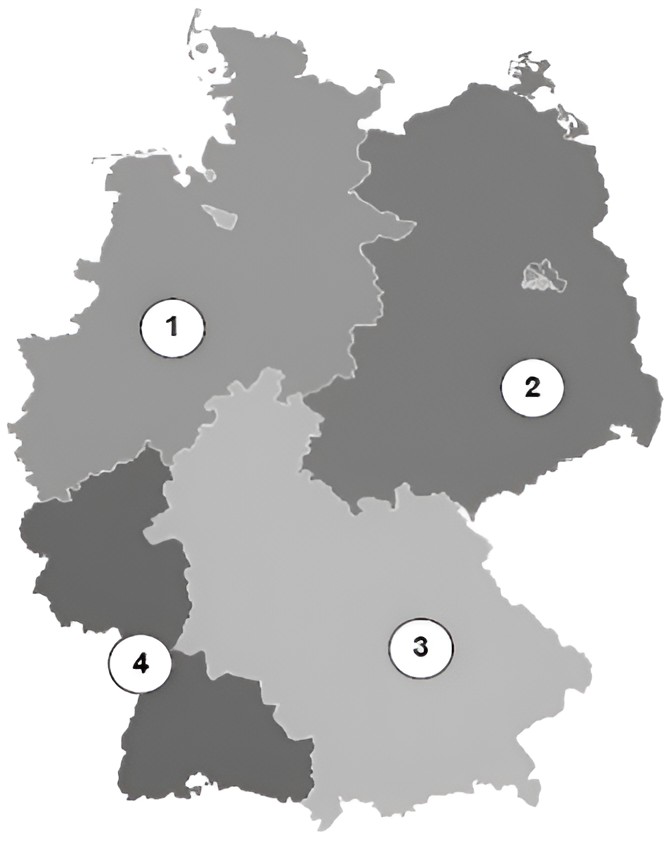
Correct answer: 1=Great Britain, 2=Soviet Union, 3=USA, 4=France
On the standard map Great Britain ran the north (1), the Soviet Union the east (2), the USA the south (3) and France the south-west (4). The three western zones became the Federal Republic in 1949, while the Soviet zone became the GDR.
-
Question 3Not answered
Which German state was formerly part of the GDR?
Correct answer: Saxony-Anhalt
Saxony-Anhalt in central Germany was part of the GDR until 1990 and is today one of the five new federal states. Its capital is Magdeburg; the region is famous as the cradle of the Reformation around Wittenberg and Eisleben.
-
Question 4Not answered
What is not a feature of our democracy?
Correct answer: press censorship
Press censorship contradicts Article 5 of the Basic Law, which explicitly forbids censorship, and is a hallmark of dictatorships. Free elections, freedom of opinion and the separation of powers, by contrast, are pillars of democracy.
-
Question 5Not answered
Who decides on a new law in Germany?
Correct answer: the parliament
Laws in Germany are passed by parliament, namely the Bundestag, often with the consent of the Bundesrat. At state level the Landtage pass state laws; the government can only introduce bills, not enact laws itself.
-
Question 6Not answered
For how many years is the Bundestag elected in Germany?
Correct answer: 4 years
Under Article 39 of the Basic Law the Bundestag is elected for four years. The legislative term ends when a new Bundestag convenes; early dissolution is only possible via Article 68 (a lost vote of confidence).
-
Question 7Not answered
What does "popular sovereignty" mean? All state power emanates from the ...
Correct answer: the people.
Popular sovereignty means that all state authority emanates from the people (Article 20(2) of the Basic Law). It is exercised through elections and votes and via the legislature, executive and judiciary.
-
Question 8Not answered
Which court in Germany has jurisdiction to interpret the Basic Law?
Correct answer: Federal Constitutional Court
The Federal Constitutional Court in Karlsruhe is responsible for interpreting the Basic Law under Article 93. It reviews laws for constitutionality, decides on constitutional complaints by citizens and state organs, and can ban political parties.
-
Question 9Not answered
What is the flag of the European Union?
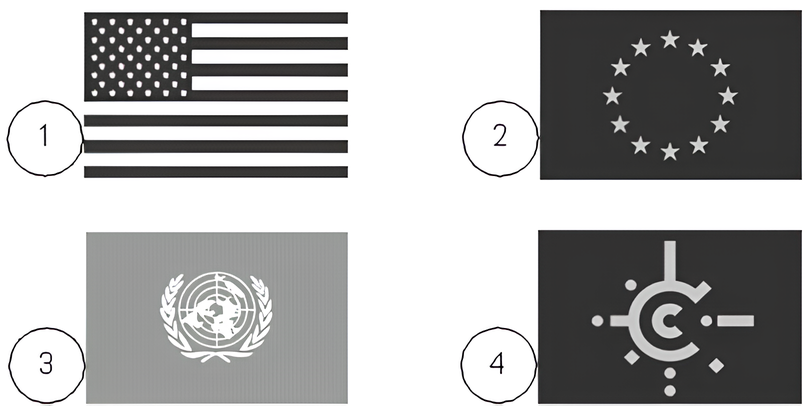
Correct answer: Picture 2
The European Union flag shows twelve gold stars arranged in a circle on a blue background. The number twelve symbolises perfection and unity, not the member states; it was adopted from the Council of Europe in 1985.
-
Question 10Not answered
Which was the coat of arms of the German Democratic Republic?
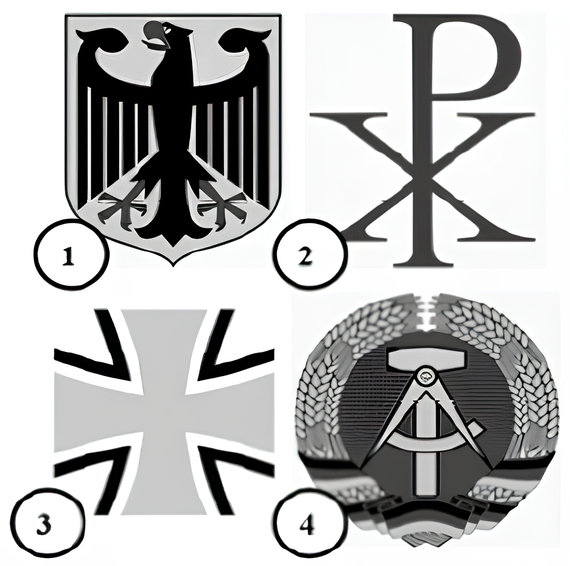
Correct answer: Picture 4
The GDR's coat of arms showed a hammer and a pair of compasses inside a ring of grain on a red background, symbolising workers, intelligentsia and farmers. It was introduced in 1955 and abolished in 1990 on accession to the Federal Republic.
-
Question 11Not answered
What does a lay judge do in Germany? He / she ...
Correct answer: decides with judges on guilt and punishment.
Lay judges (Schöffen) are honorary judges who decide on guilt and sentence in criminal trials together with the professional judges. Their vote carries the same weight as a professional judge's under Section 30 of the Courts Constitution Act.
-
Question 12Not answered
Why is there more than one party in a democracy?
Correct answer: because it represents the different opinions of citizens
A multi-party system is a hallmark of every pluralist democracy: different opinions and interests can organise themselves into separate parties and compete for votes. In a one-party dictatorship this is not possible.
-
Question 13Not answered
The adult education centre in Germany is an institution ...
Correct answer: for further education.
The Volkshochschule (VHS) is a municipal institution for general adult education. It offers affordable courses in languages, IT, careers, health and culture, as well as integration and literacy courses.
-
Question 14Not answered
The 50th anniversary of the "Treaties of Rome" was celebrated in 2007. What was the content of the treaties?
Correct answer: Foundation of the European Economic Community (EEC)
The Treaties of Rome were signed on 25 March 1957 by six states, including the Federal Republic, founding the European Economic Community (EEC) and Euratom. They created the common market and are seen as the birth of today's EU.
-
Question 15Not answered
Who built the wall in Berlin?
Correct answer: the GDR
The Berlin Wall was built in 1961 by the GDR to stop its citizens fleeing en masse via West Berlin to the Federal Republic. Until its opening on 9 November 1989 it divided East and West Berlin and became the iconic symbol of the Cold War.
-
Question 16Not answered
Which country is a neighbouring country of Germany?
Correct answer: Czech Republic
The Czech Republic borders Germany to the southeast along roughly 810 kilometres, mainly Bavaria and Saxony. It has been an EU member since 2004 and is part of the Schengen Area.
-
Question 17Not answered
Which insurance does long-term care insurance belong to?
Correct answer: Social insurance
Long-term care insurance was introduced in 1995 as the fifth pillar of social security and is regulated in Book XI of the Social Code. It joins health, pension, unemployment and accident insurance as part of statutory social insurance.
-
Question 18Not answered
What form of government does Germany have?
Correct answer: Republic
Germany is a republic: the head of state is elected rather than determined by hereditary succession. Article 20 of the Basic Law also defines the Federal Republic as a democratic and social federal state.
-
Question 19Not answered
Which politician is associated with the "Ostverträge"?
Correct answer: Willy Brandt
Chancellor Willy Brandt (SPD, 1969–1974) pursued détente with the Eastern Bloc through his Neue Ostpolitik. The Eastern Treaties with Moscow and Warsaw (1970) and the Basic Treaty with the GDR (1972) earned him the 1971 Nobel Peace Prize.
-
Question 20Not answered
Where do you have to go first in Germany if you want to get married?
Correct answer: to the registry office
In Germany, only a civil ceremony at the registry office (Standesamt) makes a marriage legally valid (§1310 BGB). A religious ceremony may follow but does not replace the civil marriage.
-
Question 21Not answered
What applies to most children in Germany?
Correct answer: Compulsory school attendance
Every child in Germany must attend school from age 6; homeschooling is not permitted. The duration of compulsory schooling is 9 or 10 years depending on the federal state.
-
Question 22Not answered
A lay judge in Germany is ...
Correct answer: a lay judge.
Lay judges (Schöffen) are honorary judges without legal training who sit alongside professional judges in criminal trials. They are appointed for five years and have the same voting power as professional judges on guilt and sentence.
-
Question 23Not answered
Which German city was divided into four sectors after the Second World War?
Correct answer: Berlin
Berlin was divided into four sectors after the Second World War – American, British, French and Soviet – even though the city lay inside the Soviet zone. From this arose the later split into West Berlin and East Berlin.
-
Question 24Not answered
Most apartment blocks in Germany have "house rules". What do these house rules say? It states ...
Correct answer: Rules that all residents must adhere to.
House rules set out binding standards for everyone living in the building, such as quiet times, stairwell cleaning and rubbish disposal. When they form part of the tenancy agreement, they are binding on all tenants.
-
Question 25Not answered
Which German state had a black, red and gold flag with a hammer, compass and spike wreath?
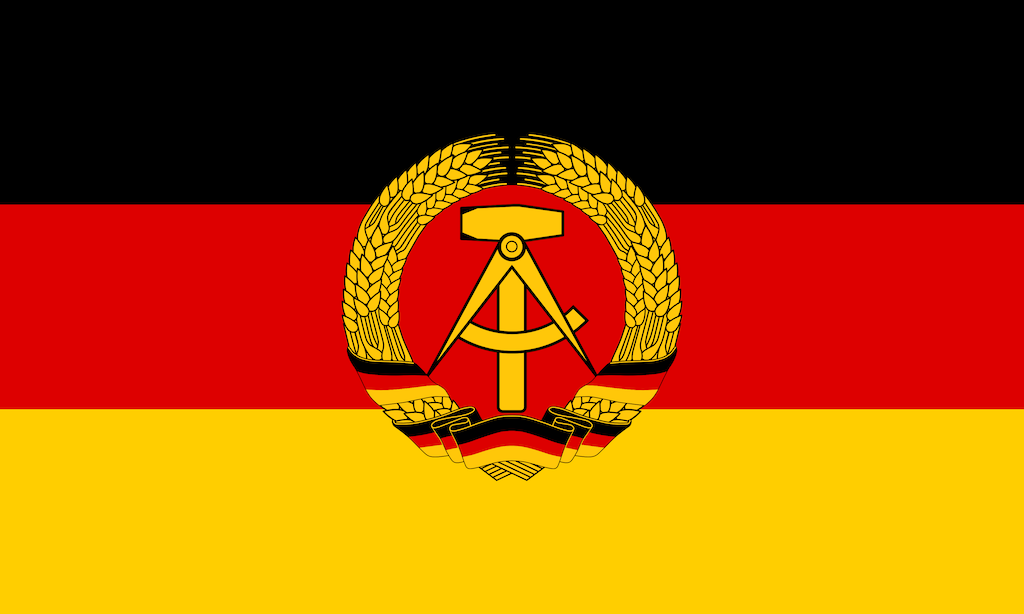
Correct answer: GDR
The GDR flag carried, on top of black-red-gold, the state emblem of hammer (workers), compass (intelligentsia) and ear-of-wheat wreath (farmers). The emblem was added in 1959; the Federal Republic uses the plain black-red-gold tricolour without symbol.
-
Question 26Not answered
Who makes up the German Bundesrat?
Correct answer: the government representatives of the federal states
The Bundesrat consists of members of the state governments, i.e. the Minister-Presidents and ministers of the federal states (Article 51). Through it the states take part in federal legislation.
-
Question 27Not answered
Where do you have to register when you move in Germany?
Correct answer: at the residents' registration office
Under §17 of the Federal Registration Act, residents must register their new address with the local Einwohnermeldeamt within two weeks of moving. A fine of up to 1,000 euros can be imposed for non-compliance.
-
Question 28Not answered
Who do the trade unions represent in Germany?
Correct answer: Employees
Trade unions represent employees in dealings with employers and the political system. They negotiate collective bargaining agreements and protect workers, for example through the right to strike, derived from freedom of association in Article 9(3) of the Basic Law.
-
Question 29Not answered
Elections in Germany are won by the party that ...
Correct answer: gets the most votes.
A German election is won by the party that receives the most votes, because seat shares in the Bundestag are calculated from the second vote (Zweitstimme). However, that party can only govern if it secures a majority of MPs, usually by forming a coalition.
-
Question 30Not answered
A man aged 30 would like to do his Abitur in Germany. Where can he do this? At ...
Correct answer: an evening grammar school
Even as an adult, the Abitur can be obtained at an Abendgymnasium. Applicants usually need completed vocational training or several years of work experience; classes take place in the evening alongside employment.


-
Question 31Not answered
The state capital of Baden-Württemberg is called ...
Correct answer: Stuttgart.
Stuttgart, with around 630,000 residents, is Baden-Württemberg's state capital and home to its parliament and government. The city on the Neckar is known for its car and engineering industry, including Mercedes-Benz and Porsche.
-
Question 32Not answered
Which federal state is Baden-Württemberg?
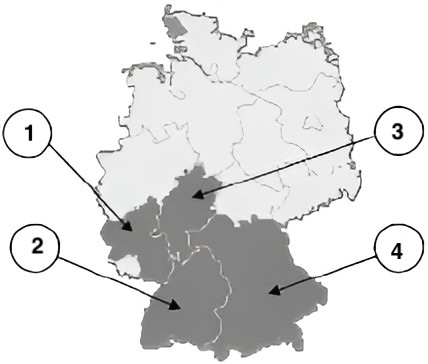
Correct answer: Picture 2
Baden-Württemberg lies in south-western Germany and borders France and Switzerland. It was formed in 1952 by merging the former states of Württemberg-Baden, Baden and Württemberg-Hohenzollern.
-
Question 33Not answered
What do you call the head of government in Baden-Württemberg?
Correct answer: Minister-President
The head of government of a German territorial state such as Baden-Württemberg holds the title of Minister-President. He or she is elected by the state parliament and leads the cabinet.

-
Question 31Not answered
The state capital of Bavaria is called ...
Correct answer: Munich.
Munich, with about 1.5 million residents, is the capital of the Free State of Bavaria and Germany's third-largest city. It hosts the state parliament and government and is known worldwide for the Oktoberfest.
-
Question 32Not answered
Which federal state is Bavaria?
Correct answer: Picture 4
Bavaria lies in south-eastern Germany and, at about 70,500 square kilometres, is the largest federal state by area. It borders Austria and the Czech Republic and is officially named the Free State of Bavaria.
-
Question 33Not answered
What do you call the head of government in Bavaria?
Correct answer: Minister-President
Bavaria's head of government holds the title Minister-President and is elected by the state parliament. He leads the cabinet and represents the Free State externally, including in the federal Bundesrat.

-
Question 31Not answered
Which federal state is a city state?
Correct answer: Berlin
Berlin is one of Germany's three city-states alongside Hamburg and Bremen, functioning as both a city and a federal state. With around 3.8 million residents, it is also Germany's largest city.
-
Question 32Not answered
Which federal state is Berlin?
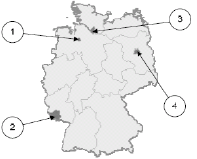
Correct answer: Picture 4
Since reunification in 1990 Berlin has again been Germany's capital and at the same time its own federal state in the form of a city-state. The city is fully surrounded by the state of Brandenburg.
-
Question 33Not answered
What do you call the head of government of the city state of Berlin?
Correct answer: Governing Mayor / Governing Mayoress
Berlin's head of government is called the Governing Mayor and leads the Berlin Senate. This title is unique to Berlin among Germany's federal states.

-
Question 31Not answered
The state capital of Brandenburg is called ...
Correct answer: Potsdam.
Potsdam, with around 185,000 residents, is Brandenburg's state capital and lies just south-west of Berlin. The city is famous for Sanssouci Palace and its Prussian palace landscape.
-
Question 32Not answered
Which federal state is Brandenburg?
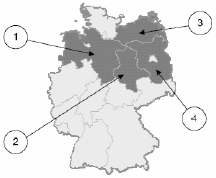
Correct answer: Picture 4
Brandenburg lies in north-eastern Germany and fully surrounds the federal capital Berlin. The state was re-established as a federal state in 1990 with German reunification.
-
Question 33Not answered
What do you call the head of government in Brandenburg?
Correct answer: Minister-President
Brandenburg's head of government holds the title of Minister-President and is elected by the state parliament in Potsdam. He leads the cabinet and represents the state in the federal Bundesrat.

-
Question 31Not answered
What is a German city state?
Correct answer: Bremen
Bremen is one of Germany's three city-states alongside Berlin and Hamburg and comprises the cities of Bremen and Bremerhaven. With about 680,000 residents it is Germany's smallest federal state.
-
Question 32Not answered
Which federal state is Bremen?
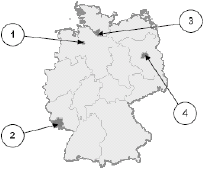
Correct answer: Picture 1
The Free Hanseatic City of Bremen lies in north-western Germany and comprises the two non-contiguous cities of Bremen and Bremerhaven, both surrounded by Lower Saxony. Bremen hosts major ports and shipyards.
-
Question 33Not answered
What do you call the head of government of the city state of Bremen?
Correct answer: President of the Senate
Bremen's head of government holds the title President of the Senate and is simultaneously Mayor of the city of Bremen. He leads the Bremen Senate and represents the state externally.

-
Question 31Not answered
Which federal state is a city state?
Correct answer: Hamburg
Hamburg is one of Germany's three city-states alongside Berlin and Bremen, functioning as both city and federal state. With around 1.9 million residents it is Germany's second-largest city.
-
Question 32Not answered
Which federal state is Hamburg?
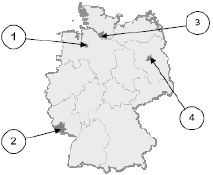
Correct answer: Picture 3
The Free and Hanseatic City of Hamburg lies in northern Germany on the Elbe and is a city-state. The Port of Hamburg is Europe's third-largest container port.
-
Question 33Not answered
What do you call the head of government of the city state of Hamburg?
Correct answer: First Mayor / First Mayoress
Hamburg's head of government holds the title First Mayor and leads the Hamburg Senate. The title distinguishes the office from ordinary mayors of other cities.

-
Question 31Not answered
The state capital of Hesse is called ...
Correct answer: Wiesbaden.
Wiesbaden, with around 280,000 residents, is the capital of Hesse and seat of its state parliament. The city on the Rhine is known as a traditional spa town with hot springs.
-
Question 32Not answered
Which federal state is Hesse?
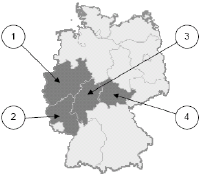
Correct answer: Picture 3
Hesse lies in central Germany, stretching from the Rhine-Main area in the south to the highlands in the north. Its economic centre is the banking metropolis of Frankfurt am Main.
-
Question 33Not answered
What do you call the head of government in Hesse?
Correct answer: Minister-President
Hesse's head of government holds the title Minister-President and is elected by the state parliament in Wiesbaden. He leads the cabinet and represents Hesse in the federal Bundesrat.

-
Question 31Not answered
The state capital of Mecklenburg-Vorpommern is called ...
Correct answer: Schwerin.
Schwerin, with around 95,000 residents, is the capital of Mecklenburg-Vorpommern and one of Germany's smallest state capitals. Its landmark is Schwerin Castle on an island in Lake Schwerin.
-
Question 32Not answered
Which federal state is Mecklenburg-Vorpommern?
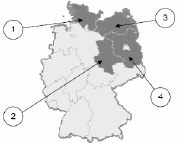
Correct answer: Picture 3
Mecklenburg-Vorpommern lies in north-eastern Germany on the Baltic and was re-established in 1990 with reunification, combining the former Rostock, Schwerin and Neubrandenburg districts. It is the most sparsely populated territorial state.
-
Question 33Not answered
What do you call the head of government in Mecklenburg-Vorpommern?
Correct answer: Minister-President
Mecklenburg-Vorpommern's head of government holds the title Minister-President and is elected by the state parliament in Schwerin. He leads the cabinet and represents the state in the federal Bundesrat.

-
Question 31Not answered
The state capital of Lower Saxony is called ...
Correct answer: Hannover.
Hannover is the capital of Lower Saxony and, with about 540,000 inhabitants, its largest city. It is known for the Hannover trade fair and houses the state parliament and chancellery in the Leineschloss.
-
Question 32Not answered
Which federal state is Lower Saxony?
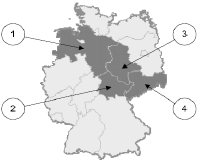
Correct answer: Picture 1
Lower Saxony is Germany's second-largest state by area, stretching from the North Sea to the Harz and Weser. It was created in 1946 by merging Hannover, Oldenburg, Brunswick and Schaumburg-Lippe.
-
Question 33Not answered
What do you call the head of government in Lower Saxony?
Correct answer: Minister-President
Lower Saxony's head of government is the Minister-President, elected by the state parliament. They lead the state cabinet, appoint ministers and represent the state in the Bundesrat.

-
Question 31Not answered
The state capital of North Rhine-Westphalia is called ...
Correct answer: Düsseldorf.
Düsseldorf is the capital of North Rhine-Westphalia, sits on the Rhine and has about 620,000 inhabitants. The state's largest city is actually Cologne; Düsseldorf hosts the parliament and state chancellery.
-
Question 32Not answered
Which federal state is North Rhine-Westphalia?
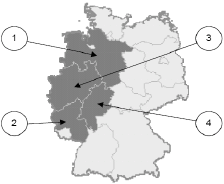
Correct answer: Picture 3
North Rhine-Westphalia is Germany's most populous state, with almost 18 million inhabitants. Lying in the west on the borders with the Netherlands and Belgium, it was founded in 1946 under British occupation.
-
Question 33Not answered
What do you call the head of government in North Rhine-Westphalia?
Correct answer: Minister-President
North Rhine-Westphalia's head of government is the Minister-President, elected by the state parliament. They lead the cabinet in Düsseldorf, set policy guidelines and appoint the ministers.

-
Question 31Not answered
The state capital of Rhineland-Palatinate is called ...
Correct answer: Mainz.
Mainz is the capital of Rhineland-Palatinate, situated on the Rhine opposite Wiesbaden. The city of about 220,000 inhabitants is the seat of the Catholic Diocese of Mainz and the birthplace of Johannes Gutenberg.
-
Question 32Not answered
Which federal state is Rhineland-Palatinate?
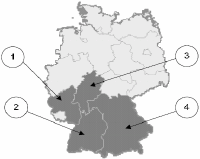
Correct answer: Picture 1
Rhineland-Palatinate in western Germany was founded in 1946 and borders France, Luxembourg and Belgium. The state is renowned for its wine regions along the Rhine, Moselle and Ahr rivers.
-
Question 33Not answered
What do you call the head of government in Rhineland-Palatinate?
Correct answer: Minister-President
Rhineland-Palatinate's head of government holds the title of Minister-President and is elected by the state parliament. They head the state chancellery in Mainz and represent the state in the Bundesrat.

-
Question 31Not answered
The state capital of Saarland is called ...
Correct answer: Saarbrücken.
Saarbrücken is the capital of Saarland and lies directly on the border with France. With about 180,000 inhabitants, it hosts the state parliament, the university and major government offices.
-
Question 32Not answered
Which federal state is Saarland?
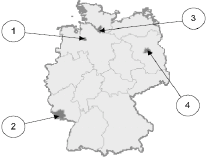
Correct answer: Picture 2
Saarland is the smallest German territorial state by area and population, surpassed only by the city-states. After WWII it was administered by France and joined the Federal Republic in 1957.
-
Question 33Not answered
What do you call the head of government of Saarland?
Correct answer: Minister-President
Saarland's head of government is called the Minister-President, elected by the state parliament. They head the state chancellery in Saarbrücken and represent Saarland in the Bundesrat in Berlin.

-
Question 31Not answered
The state capital of Saxony is called ...
Correct answer: Dresden.
Dresden is the capital of Saxony, situated on the Elbe. Home to the Frauenkirche, Zwinger and Semper Opera, this city of about 560,000 is a major cultural and Baroque heritage centre.
-
Question 32Not answered
Which federal state is Saxony?
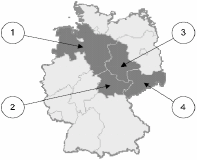
Correct answer: Picture 4
Saxony is a Free State in eastern Germany and one of the five new states formed after reunification in 1990. It borders Poland and the Czech Republic and has about four million inhabitants.
-
Question 33Not answered
What do you call the head of government in Saxony?
Correct answer: Minister-President
Saxony's head of government is called the Minister-President, elected by the state parliament. They lead the state government in Dresden and represent the Free State in the Bundesrat.

-
Question 31Not answered
The state capital of Saxony-Anhalt is called ...
Correct answer: Magdeburg.
Magdeburg is the capital of Saxony-Anhalt, situated on the Elbe. The city of about 240,000 traces its origins to an imperial palace of Otto the Great and houses one of Germany's oldest Gothic cathedrals.
-
Question 32Not answered
Which federal state is Saxony-Anhalt?
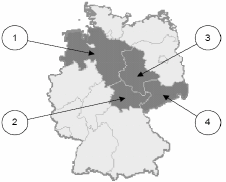
Correct answer: Picture 3
Saxony-Anhalt lies in central Germany and was re-established in 1990 with reunification. The cradle of the Reformation, it hosts UNESCO sites including Wittenberg, Quedlinburg and the Bauhaus in Dessau.
-
Question 33Not answered
What do you call the head of government in Saxony-Anhalt?
Correct answer: Minister-President
Saxony-Anhalt's head of government is called the Minister-President, elected by the state parliament. They lead the state chancellery in Magdeburg and represent the state in the Bundesrat.

-
Question 31Not answered
The state capital of Schleswig-Holstein is called ...
Correct answer: Kiel.
Kiel is the capital of Schleswig-Holstein, lying on the Baltic coast. This port city of about 250,000 inhabitants hosts the state parliament and is known for the annual Kiel Week sailing event.
-
Question 32Not answered
Which federal state is Schleswig-Holstein?
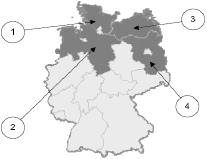
Correct answer: Picture 1
Schleswig-Holstein is Germany's northernmost state, lying between the North and Baltic Seas. It borders Denmark; the duchies passed to Prussia after the Second Schleswig War of 1864.
-
Question 33Not answered
What do you call the head of government in Schleswig-Holstein?
Correct answer: Minister-President
Schleswig-Holstein's head of government is the Minister-President, elected by the state parliament. They head the state chancellery in Kiel and represent the state in the Bundesrat.

-
Question 31Not answered
The state capital of Thuringia is called ...
Correct answer: Erfurt.
Erfurt is the capital of Thuringia and, with about 215,000 inhabitants, its largest city. It is known for its medieval cathedral, the Krämerbrücke and the Augustinian monastery where Martin Luther lived.
-
Question 32Not answered
Which federal state is Thuringia?
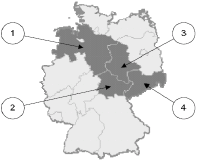
Correct answer: Picture 2
Thuringia lies at the heart of Germany and is often called the Green Heart. The Free State was re-established at reunification in 1990 and is home to UNESCO sites such as Weimar and the Wartburg.
-
Question 33Not answered
What do you call the head of government in Thuringia?
Correct answer: Minister-President
Thuringia's head of government is called the Minister-President, elected by the state parliament. They lead the Thuringian state chancellery in Erfurt and represent the state in the Bundesrat.

Your result
/ 33 correct
You pass with 17 or more correct answers.