Practice test 6
33 questions · 60 minutes · pass with 17
Answer every question, then tap Check results. Only then will you see which answers were right.
-
Question 1Not answered
You have bought a television in Germany. You unpack the television at home, but it does not work. The television is broken. What can you do?
Correct answer: complain about the television
A defective new product carries the statutory two-year warranty (§§434, 437 BGB): the buyer can complain and demand repair, replacement or a refund. A manufacturer's guarantee may apply on top.
-
Question 2Not answered
How many federal states does the Federal Republic of Germany have?
Correct answer: 16
The Federal Republic consists of 16 states, three of which are city-states (Berlin, Hamburg and Bremen). Since reunification in 1990 the five new eastern states have formed part of this total.
-
Question 3Not answered
What does each German state have?
Correct answer: its own government
Each of the 16 states has its own government, its own parliament and its own constitution. This allows the states to shape areas such as education, police and culture themselves (cultural sovereignty of the Länder).
-
Question 4Not answered
Which country is a neighbouring country of Germany?
Correct answer: Poland
Poland is Germany's eastern neighbour; the roughly 460 km border runs along the Oder and Neisse rivers. Both countries are EU members and belong to the Schengen Area.
-
Question 5Not answered
What can I do in Germany if my employer has unfairly dismissed me?
Correct answer: file an action for unfair dismissal
Against an unjust dismissal you can file a wrongful-dismissal action with the labour court. Under Section 4 of the Dismissal Protection Act the deadline is three weeks from receipt of the termination; afterwards the dismissal is deemed valid.
-
Question 6Not answered
If you want to defend yourself against an incorrect tax assessment in Germany, you must ...
Correct answer: lodge an objection.
Under §347 of the Fiscal Code, you can file a written objection (Einspruch) against a tax assessment with the tax office within one month. The procedure is free of charge; only if rejected does a lawsuit before the tax court follow.
-
Question 7Not answered
Mrs Frost works as a permanent employee in an office. What does she not have to pay from her salary?
Correct answer: Value added tax
VAT is levied on the sale of goods and services and paid by the business, not deducted from wages. The gross salary is reduced by income tax, church tax, solidarity surcharge and social-security contributions.
-
Question 8Not answered
Which cities have the largest Jewish communities in Germany?
Correct answer: Berlin and Munich
The largest Jewish communities in Germany are located in Berlin and Munich. Both cities have several thousand members, many of whom arrived through immigration from the former Soviet Union after 1990.
-
Question 9Not answered
A party wants to enter the German Bundestag. However, it must have a minimum share of votes. This means ...
Correct answer: 5 % hurdle.
The threshold of five percent is called the 5 % hurdle. A party must reach at least 5 % of the second votes to obtain seats in the Bundestag; otherwise its votes do not count, which prevents the fragmentation of parliament.
-
Question 10Not answered
What is required for a divorce in Germany?
Correct answer: the assistance of a lawyer
Divorce proceedings before the family court require legal representation: at least the spouse filing the petition must be represented by a lawyer (§114 FamFG). Divorce is not possible without a lawyer.
-
Question 11Not answered
Which of today's German states used to be part of the GDR?
Correct answer: Brandenburg
Brandenburg lies in eastern Germany and was part of the GDR until reunification in 1990. It is one of the five "new federal states" that joined the Federal Republic in 1990. Its capital is Potsdam, and it surrounds the city of Berlin.
-
Question 12Not answered
Which principle governs elections in Germany? Elections in Germany are ...
Correct answer: free, equal, secret.
Article 38 of the Basic Law states that elections must be general, direct, free, equal and secret. Every ballot counts the same (equal), every voter chooses without coercion (free) and no one may learn how anyone voted (secret).
-
Question 13Not answered
What does the abbreviation CSU mean in Germany?
Correct answer: Christian Social Union
CSU stands for Christlich Soziale Union in Bayern (Christian Social Union in Bavaria). It only stands for election in Bavaria and forms a joint parliamentary group with the CDU in the Bundestag.
-
Question 14Not answered
In Germany, people are allowed to say something openly against the government because ...
Correct answer: freedom of opinion applies here.
Article 5 of the Basic Law guarantees freedom of expression: everyone may freely voice opinions in speech, writing and image, including criticism of the government. The Basic Law also explicitly states that there shall be no censorship.
-
Question 15Not answered
How can someone who denies the Holocaust be punished?
Correct answer: imprisonment for up to five years or a fine
Publicly denying the Holocaust is a criminal offence under § 130(3) of the Criminal Code (incitement of the masses) and is punishable by up to five years' imprisonment or a fine. Approval and trivialisation are equally covered.
-
Question 16Not answered
In Germany, the last four weeks before Christmas are called ...
Correct answer: the Advent season.
Advent comprises the four Sundays before Christmas and prepares Christians for the birth of Jesus. Customs include the Advent wreath, Advent calendar and specially designed candles.
-
Question 17Not answered
When is freedom of opinion restricted in Germany?
Correct answer: in the public dissemination of false allegations about individuals
Freedom of opinion is limited by general laws, youth protection and the right to personal honour (Art. 5(2)). Spreading knowingly false claims about a specific person can be prosecuted as defamation or slander under §§ 186 and 187 of the Criminal Code.
-
Question 18Not answered
What did the expression "Iron Curtain" stand for? For the sealing off ...
Correct answer: the Warsaw Pact against the West.
The expression "Iron Curtain" – coined by Winston Churchill in 1946 – stood for the sealing-off of the communist Warsaw Pact states from the West. It divided Europe into two political blocs throughout the Cold War.
-
Question 19Not answered
What can you be honoured with in the Federal Republic of Germany if you have made a special achievement in the political, economic, cultural, intellectual or social field? With the ...
Correct answer: Federal Cross of Merit
The Federal Cross of Merit (Verdienstorden der Bundesrepublik Deutschland) is Germany's only general federal decoration, established in 1951 by President Theodor Heuss. The Federal President awards it for outstanding achievements in political, economic, cultural, intellectual or social life.
-
Question 20Not answered
What does "popular sovereignty" mean?
Correct answer: The power of the state emanates from the people.
Popular sovereignty means that all state authority emanates from the people (Art. 20(2) of the Basic Law). The people exercise it through elections and votes and through the organs of legislation, administration and the judiciary.
-
Question 21Not answered
When were the National Socialists in power in Germany?
Correct answer: 1933 to 1945
The Nazi dictatorship lasted from Hitler's appointment as Chancellor on 30 January 1933 to Germany's surrender on 8 May 1945. During this period basic rights were suspended, dissidents were persecuted and six million Jews were murdered in the Holocaust.
-
Question 22Not answered
What is primarily a task of the federal states in Germany?
Correct answer: School policy
Education policy is a matter for the states and part of their cultural sovereignty (Articles 30 and 70 of the Basic Law). Each state defines its own curricula, school types and qualifications, with nationwide coordination via the Conference of Ministers of Education.
-
Question 23Not answered
Who determines school policy in Germany?
Correct answer: the federal states
Education is a matter of state (Länder) sovereignty under Articles 30 and 70 of the Basic Law. Each state sets its own curricula, school types and holiday dates, coordinated through the Conference of Ministers of Education (KMK).
-
Question 24Not answered
The German Federal President Gustav Heinemann gives Helmut Schmidt the certificate of appointment as German Federal Chancellor in 1974. What are the duties of the German Federal President?
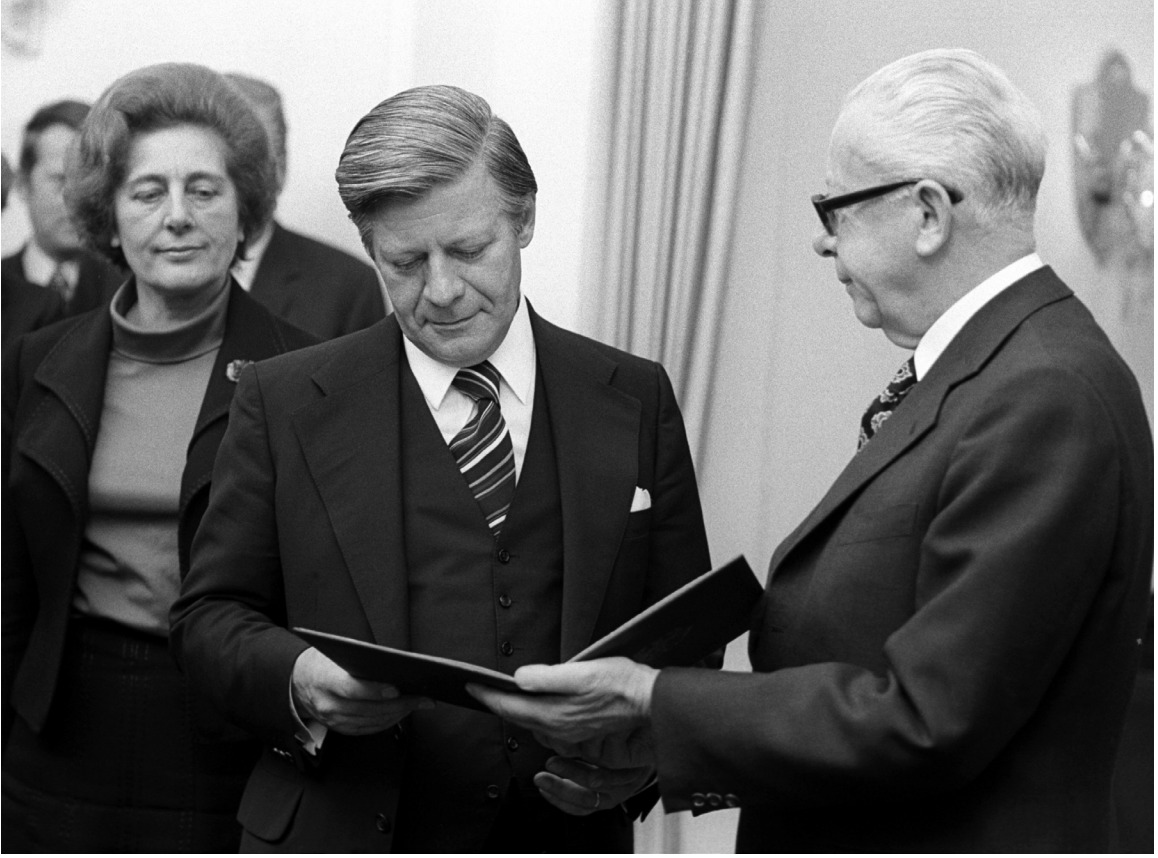
Correct answer: He/she proposes the Chancellor for election.
Under Article 63 of the Basic Law, the Federal President proposes a candidate for Chancellor to the Bundestag and appoints the winner. The decisive factor in practice is which candidate has a majority in the Bundestag.
-
Question 25Not answered
The Federal Republic of Germany has a three-tier administrative structure. What is the name of the lowest political level?
Correct answer: Municipalities
The lowest political level of Germany's three-tier administration (federation, states, municipalities) is the municipality (Gemeinde). Their right to self-government is guaranteed by Article 28(2) of the Basic Law and underpins local administration close to the citizen.
-
Question 26Not answered
Today, the Federal Republic of Germany is divided into ...
Correct answer: federal, state and local authorities.
Germany is organised on three administrative levels: the federation, the states and the municipalities. This structure ensures local government close to the citizen and is enshrined in Article 28 of the Basic Law.
-
Question 27Not answered
Who heads the German Federal Cabinet?
Correct answer: the Federal Chancellor
The Chancellor heads the Federal Cabinet and, under Article 65, determines the guidelines of government policy. This "directive authority" (Richtlinienkompetenz) makes the Chancellor the most powerful member of the government and gives Germany its "chancellor democracy."
-
Question 28Not answered
What is the job of a judge in Germany?
Correct answer: To dispense justice
A judge's main task is to dispense justice, that is, to decide bindingly how the law applies to a concrete dispute. Under Article 97 of the Basic Law judges are independent and subject only to the law.
-
Question 29Not answered
Taking part in democratic elections in Germany is ...
Correct answer: a right.
Voting in Germany is a constitutional right under Article 38 of the Basic Law, not a duty. No one may be penalised for staying home; unlike in Belgium or Australia, German law imposes no compulsory voting.
-
Question 30Not answered
What does the abbreviation DDR mean?
Correct answer: German Democratic Republic
DDR is the abbreviation for Deutsche Demokratische Republik (German Democratic Republic), the East German state that existed from 1949 to 1990. Despite the name it was not a democracy but a one-party dictatorship under the SED.

-
Question 31Not answered
Where can you find out about political issues in Baden-Württemberg?
Correct answer: at the State Centre for Political Education
The Baden-Württemberg State Centre for Political Education (LpB) in Stuttgart offers free information, brochures and events on political topics. It is a non-partisan institution of the state government.
-
Question 32Not answered
The state capital of Baden-Württemberg is called ...
Correct answer: Stuttgart.
Stuttgart, with around 630,000 residents, is Baden-Württemberg's state capital and home to its parliament and government. The city on the Neckar is known for its car and engineering industry, including Mercedes-Benz and Porsche.
-
Question 33Not answered
Which federal state is Baden-Württemberg?
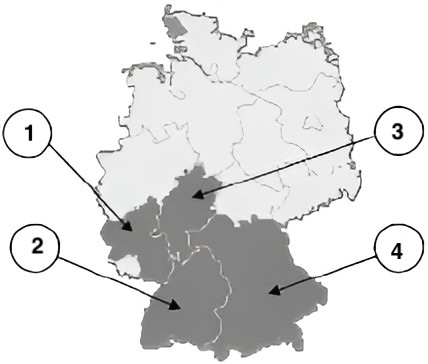
Correct answer: Picture 2
Baden-Württemberg lies in south-western Germany and borders France and Switzerland. It was formed in 1952 by merging the former states of Württemberg-Baden, Baden and Württemberg-Hohenzollern.

-
Question 31Not answered
Where can you find out about political issues in Bavaria?
Correct answer: at the State Centre for Political Education
The Bavarian State Centre for Political Education in Munich provides free information on political and social topics. It is non-partisan and publishes books, brochures and online materials.
-
Question 32Not answered
The state capital of Bavaria is called ...
Correct answer: Munich.
Munich, with about 1.5 million residents, is the capital of the Free State of Bavaria and Germany's third-largest city. It hosts the state parliament and government and is known worldwide for the Oktoberfest.
-
Question 33Not answered
Which federal state is Bavaria?
Correct answer: Picture 4
Bavaria lies in south-eastern Germany and, at about 70,500 square kilometres, is the largest federal state by area. It borders Austria and the Czech Republic and is officially named the Free State of Bavaria.

-
Question 31Not answered
Where can you find out about political issues in Berlin?
Correct answer: at the State Centre for Political Education
Berlin's State Centre for Political Education is a non-partisan body offering free information, events and publications on political topics. It is based at Hausvogteiplatz in Berlin-Mitte.
-
Question 32Not answered
Which federal state is a city state?
Correct answer: Berlin
Berlin is one of Germany's three city-states alongside Hamburg and Bremen, functioning as both a city and a federal state. With around 3.8 million residents, it is also Germany's largest city.
-
Question 33Not answered
Which federal state is Berlin?
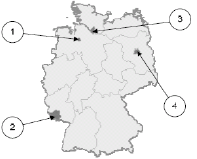
Correct answer: Picture 4
Since reunification in 1990 Berlin has again been Germany's capital and at the same time its own federal state in the form of a city-state. The city is fully surrounded by the state of Brandenburg.

-
Question 31Not answered
Where can you find out about political issues in Brandenburg?
Correct answer: at the State Centre for Political Education
Brandenburg's State Centre for Political Education in Potsdam provides non-partisan information and events on political topics. It serves as a contact point for the state's citizens.
-
Question 32Not answered
The state capital of Brandenburg is called ...
Correct answer: Potsdam.
Potsdam, with around 185,000 residents, is Brandenburg's state capital and lies just south-west of Berlin. The city is famous for Sanssouci Palace and its Prussian palace landscape.
-
Question 33Not answered
Which federal state is Brandenburg?
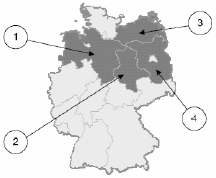
Correct answer: Picture 4
Brandenburg lies in north-eastern Germany and fully surrounds the federal capital Berlin. The state was re-established as a federal state in 1990 with German reunification.

-
Question 31Not answered
Where can you find out about political issues in Bremen?
Correct answer: at the State Centre for Political Education
Bremen's State Centre for Political Education provides non-partisan information, brochures and events on political topics. It is run by the Bremen state government.
-
Question 32Not answered
What is a German city state?
Correct answer: Bremen
Bremen is one of Germany's three city-states alongside Berlin and Hamburg and comprises the cities of Bremen and Bremerhaven. With about 680,000 residents it is Germany's smallest federal state.
-
Question 33Not answered
Which federal state is Bremen?
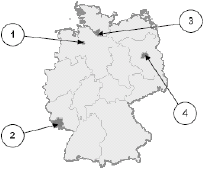
Correct answer: Picture 1
The Free Hanseatic City of Bremen lies in north-western Germany and comprises the two non-contiguous cities of Bremen and Bremerhaven, both surrounded by Lower Saxony. Bremen hosts major ports and shipyards.

-
Question 31Not answered
Where can you find out about political issues in Hamburg?
Correct answer: at the State Centre for Political Education
Hamburg's State Centre for Political Education offers non-partisan information, events and publications on political topics. It is located in central Hamburg.
-
Question 32Not answered
Which federal state is a city state?
Correct answer: Hamburg
Hamburg is one of Germany's three city-states alongside Berlin and Bremen, functioning as both city and federal state. With around 1.9 million residents it is Germany's second-largest city.
-
Question 33Not answered
Which federal state is Hamburg?
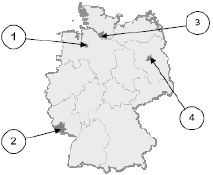
Correct answer: Picture 3
The Free and Hanseatic City of Hamburg lies in northern Germany on the Elbe and is a city-state. The Port of Hamburg is Europe's third-largest container port.

-
Question 31Not answered
Where can you find out about political issues in Hesse?
Correct answer: at the State Centre for Political Education
Hesse's State Centre for Political Education in Wiesbaden offers non-partisan information, publications and events on political topics. It is a state government institution.
-
Question 32Not answered
The state capital of Hesse is called ...
Correct answer: Wiesbaden.
Wiesbaden, with around 280,000 residents, is the capital of Hesse and seat of its state parliament. The city on the Rhine is known as a traditional spa town with hot springs.
-
Question 33Not answered
Which federal state is Hesse?
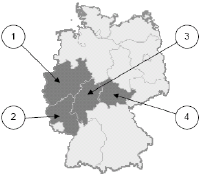
Correct answer: Picture 3
Hesse lies in central Germany, stretching from the Rhine-Main area in the south to the highlands in the north. Its economic centre is the banking metropolis of Frankfurt am Main.

-
Question 31Not answered
Where can you find out about political issues in Mecklenburg-Vorpommern?
Correct answer: at the State Centre for Political Education
Mecklenburg-Vorpommern's State Centre for Political Education in Schwerin offers non-partisan information, events and publications on political topics. It is a state government institution.
-
Question 32Not answered
The state capital of Mecklenburg-Vorpommern is called ...
Correct answer: Schwerin.
Schwerin, with around 95,000 residents, is the capital of Mecklenburg-Vorpommern and one of Germany's smallest state capitals. Its landmark is Schwerin Castle on an island in Lake Schwerin.
-
Question 33Not answered
Which federal state is Mecklenburg-Vorpommern?
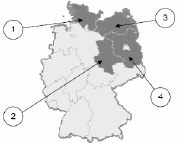
Correct answer: Picture 3
Mecklenburg-Vorpommern lies in north-eastern Germany on the Baltic and was re-established in 1990 with reunification, combining the former Rostock, Schwerin and Neubrandenburg districts. It is the most sparsely populated territorial state.

-
Question 31Not answered
Where can you find out about political issues in Lower Saxony?
Correct answer: at the Coordinator for Political Education at the Ministry of Culture
In Lower Saxony the Coordinator for Political Education at the Ministry of Culture is the official point of contact for civic information. Unlike most states, Lower Saxony has no separate State Centre for Political Education.
-
Question 32Not answered
The state capital of Lower Saxony is called ...
Correct answer: Hannover.
Hannover is the capital of Lower Saxony and, with about 540,000 inhabitants, its largest city. It is known for the Hannover trade fair and houses the state parliament and chancellery in the Leineschloss.
-
Question 33Not answered
Which federal state is Lower Saxony?
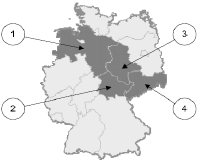
Correct answer: Picture 1
Lower Saxony is Germany's second-largest state by area, stretching from the North Sea to the Harz and Weser. It was created in 1946 by merging Hannover, Oldenburg, Brunswick and Schaumburg-Lippe.

-
Question 31Not answered
Where can you find out about political issues in North Rhine-Westphalia?
Correct answer: at the State Centre for Political Education
The State Centre for Political Education NRW provides free information on politics, history and society. Based in Düsseldorf, it runs an extensive programme of publications and public events.
-
Question 32Not answered
The state capital of North Rhine-Westphalia is called ...
Correct answer: Düsseldorf.
Düsseldorf is the capital of North Rhine-Westphalia, sits on the Rhine and has about 620,000 inhabitants. The state's largest city is actually Cologne; Düsseldorf hosts the parliament and state chancellery.
-
Question 33Not answered
Which federal state is North Rhine-Westphalia?
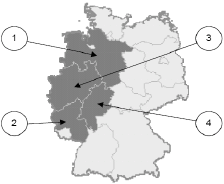
Correct answer: Picture 3
North Rhine-Westphalia is Germany's most populous state, with almost 18 million inhabitants. Lying in the west on the borders with the Netherlands and Belgium, it was founded in 1946 under British occupation.

-
Question 31Not answered
Where can you find out about political issues in Rhineland-Palatinate?
Correct answer: at the State Centre for Political Education
The State Centre for Political Education in Rhineland-Palatinate, based in Mainz, offers publications, seminars and advice on political issues. It is attached to the Ministry of the Interior.
-
Question 32Not answered
The state capital of Rhineland-Palatinate is called ...
Correct answer: Mainz.
Mainz is the capital of Rhineland-Palatinate, situated on the Rhine opposite Wiesbaden. The city of about 220,000 inhabitants is the seat of the Catholic Diocese of Mainz and the birthplace of Johannes Gutenberg.
-
Question 33Not answered
Which federal state is Rhineland-Palatinate?
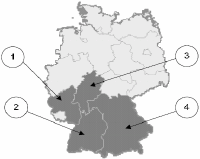
Correct answer: Picture 1
Rhineland-Palatinate in western Germany was founded in 1946 and borders France, Luxembourg and Belgium. The state is renowned for its wine regions along the Rhine, Moselle and Ahr rivers.

-
Question 31Not answered
Where can you find out about political issues in Saarland?
Correct answer: at the State Centre for Political Education
The Saarland State Centre for Political Education in Saarbrücken offers events, publications and educational programmes. It comes under the Ministry of Education and Culture.
-
Question 32Not answered
The state capital of Saarland is called ...
Correct answer: Saarbrücken.
Saarbrücken is the capital of Saarland and lies directly on the border with France. With about 180,000 inhabitants, it hosts the state parliament, the university and major government offices.
-
Question 33Not answered
Which federal state is Saarland?
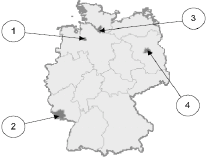
Correct answer: Picture 2
Saarland is the smallest German territorial state by area and population, surpassed only by the city-states. After WWII it was administered by France and joined the Federal Republic in 1957.

-
Question 31Not answered
Where can you find out about political issues in Saxony?
Correct answer: at the State Centre for Political Education
Saxony's State Centre for Political Education, based in Dresden, provides information on politics, history and democracy. It runs educational programmes, publications and competitions for students.
-
Question 32Not answered
The state capital of Saxony is called ...
Correct answer: Dresden.
Dresden is the capital of Saxony, situated on the Elbe. Home to the Frauenkirche, Zwinger and Semper Opera, this city of about 560,000 is a major cultural and Baroque heritage centre.
-
Question 33Not answered
Which federal state is Saxony?
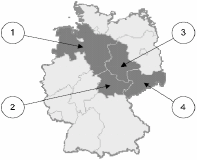
Correct answer: Picture 4
Saxony is a Free State in eastern Germany and one of the five new states formed after reunification in 1990. It borders Poland and the Czech Republic and has about four million inhabitants.

-
Question 31Not answered
Where can you find out about political issues in Saxony-Anhalt?
Correct answer: at the State Centre for Political Education
Saxony-Anhalt's State Centre for Political Education, based in Magdeburg, offers events, books and educational programmes on democracy and history. It is attached to the state chancellery.
-
Question 32Not answered
The state capital of Saxony-Anhalt is called ...
Correct answer: Magdeburg.
Magdeburg is the capital of Saxony-Anhalt, situated on the Elbe. The city of about 240,000 traces its origins to an imperial palace of Otto the Great and houses one of Germany's oldest Gothic cathedrals.
-
Question 33Not answered
Which federal state is Saxony-Anhalt?
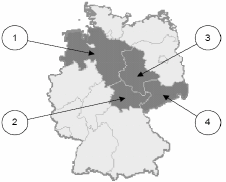
Correct answer: Picture 3
Saxony-Anhalt lies in central Germany and was re-established in 1990 with reunification. The cradle of the Reformation, it hosts UNESCO sites including Wittenberg, Quedlinburg and the Bauhaus in Dessau.

-
Question 31Not answered
Where can you find out about political issues in Schleswig-Holstein?
Correct answer: at the State Centre for Political Education
Schleswig-Holstein's State Centre for Political Education is based in Kiel. Attached to the state parliament presidency, it provides publications, seminars and educational excursions.
-
Question 32Not answered
The state capital of Schleswig-Holstein is called ...
Correct answer: Kiel.
Kiel is the capital of Schleswig-Holstein, lying on the Baltic coast. This port city of about 250,000 inhabitants hosts the state parliament and is known for the annual Kiel Week sailing event.
-
Question 33Not answered
Which federal state is Schleswig-Holstein?
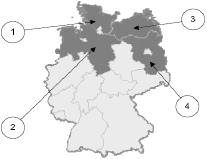
Correct answer: Picture 1
Schleswig-Holstein is Germany's northernmost state, lying between the North and Baltic Seas. It borders Denmark; the duchies passed to Prussia after the Second Schleswig War of 1864.

-
Question 31Not answered
Where can you find out about political issues in Thuringia?
Correct answer: at the State Centre for Political Education
Thuringia's State Centre for Political Education, based in Erfurt, offers publications, seminars and events. It comes under the Thuringian state chancellery.
-
Question 32Not answered
The state capital of Thuringia is called ...
Correct answer: Erfurt.
Erfurt is the capital of Thuringia and, with about 215,000 inhabitants, its largest city. It is known for its medieval cathedral, the Krämerbrücke and the Augustinian monastery where Martin Luther lived.
-
Question 33Not answered
Which federal state is Thuringia?
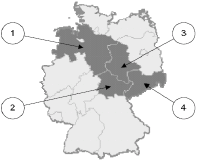
Correct answer: Picture 2
Thuringia lies at the heart of Germany and is often called the Green Heart. The Free State was re-established at reunification in 1990 and is home to UNESCO sites such as Weimar and the Wartburg.

Your result
/ 33 correct
You pass with 17 or more correct answers.